+1-802-778-9005
Home>>Tools Complete Guide to QuickBooks Tool Hub – Download, Installation, and Use Fix Installation Errors with QuickBooks Install Diagnostic Tool

Submit Your Details to Continue Reading

Navigation

Highlights (Key Facts & Solutions)

  • Primary Function: The QuickBooks Install Diagnostic Tool is the first step for resolving installation errors by automatically fixing issues related to core Microsoft components: .NET Framework, MSXML, and Visual C++.
  • Advanced Manual Fix (Component): If the tool reports “No errors,” manually registering the MSXML DLL files in the Command Prompt (e.g., regsvr32 MSXML6.dll) is the next step to address deep component corruption.
  • Advanced Manual Fix (Startup): For persistent installation failures, use the Selective Startup mode (MSConfig) to eliminate third-party software conflicts that block file installation.
  • Component Check: If the .NET Framework error persists, manually verify that .NET Framework 3.5 and 4.8 are enabled in the Windows Programs and Features settings.
  • Mandatory Action: A system restart is required after installing the Tool Hub and after running the Diagnostic Tool to finalize registry changes and allow QuickBooks to access the repaired components cleanly.
  • Error Categories Resolved: The tool resolves errors across three main categories: Runtime and Component Errors (e.g., 1935, 1722), Installation Failures (e.g., 1904, 1334), and Program Execution Errors (“QuickBooks has stopped working”).
  • Key Advantage: The Diagnostic Tool provides significant time savings by automating complex component repairs that would otherwise require advanced manual fixes, such as registry manipulation.

Overview

Here is a complete guide to the QuickBooks Install Diagnostic Tool.

QuickBooks Install Diagnostic Tool is developed to fix any issue that may occur during QuickBooks installation. It recognizes and fixes a number of issues with key components, including the .NET Framework, MSXML, and Visual C++ redistributables, which are vital for QuickBooks. Running this tool will save less time and effectively eliminate recurring errors to help ease a smoother installation.

Even after having such amazing features and functionalities, QuickBooks users have to face different error codes and technical bugs. Most of the error codes mainly occur during the installation of the QuickBooks software. Intuit has developed a perfect tool named ‘QuickBooks program diagnostic tool to fix such errors.’

How Can You Download and install the QuickBooks Install Diagnostic Tool?

The QuickBooks Install Diagnostic Tool is an effective tool that can be downloaded and installed to solve every common installation issue.

This tool automatically identifies some of the things required for QuickBooks to work and is an excellent solution for configuration issues.

Before installing the install diagnostic tool, you must follow the steps mentioned below:

  1. Close all other applications running in the background and then choose the file to access the tool.
  2. The diagnostic tool will automatically resolve the issues.
  3. If the tool shows the message “No errors were detected, “it implies that the issue remains unfixed.

Now, you can perform the following steps to download and install the diagnostic tool.

Follow the given instructions below:

Download QuickBooks Diagnostic Tool:

  1. Visit Intuit’s official QuickBooks Tool Hub Page website and Download the most recent version (1.6.0.5) of the QuickBooks Tool Hub. (which includes the QuickBooks Install Diagnostic Tool.)
  2. On the page, find and click on the link to download the QuickBooks Tool Hub. This utility contains the diagnostic tool.
  3. Wait till the download process gets completed.
  4. After that, save the downloaded file on your desktop.

Install the QuickBooks Diagnostic Tool:

  1. Once the download is complete, open the downloaded file (QuickBooksToolHub.exe).
  2. Select run and then click Yes to accept the terms and conditions.
  3. Follow the on-screen instructions to install the QuickBooks Tool Hub.
  4. Finally, restart the system.
  5. After installation, open the Tool Hub.

You have understood the steps to install the QB Diagnostic Tool. Let’s move on to the steps to fix installation errors via the install diagnostic tool for QuickBooks.

How Do You Fix Installation Errors Using the QB Install Diagnostic Tool?

According to Intuit Disclosure, the QuickBooks Install Diagnostic Tool is a beneficial tool for resolving different types of installation errors. Follow the following steps to learn how to eliminate installation errors.

Step 1: Download the QuickBooks Tool Hub

  1. Initially, close the QuickBooks Desktop and download the QuickBooks Tool Hub File from the Intuit website.
  2. After that, save the downloaded file on your desktop.
  3. Finally, open the file having the extension of QuickBooksToolHub.exe
  4. Go through the on0screen instructions to install the hub tool.
  5. Select Next to accept the terms and conditions.
  6. Double-tap on the tool hub to access it.

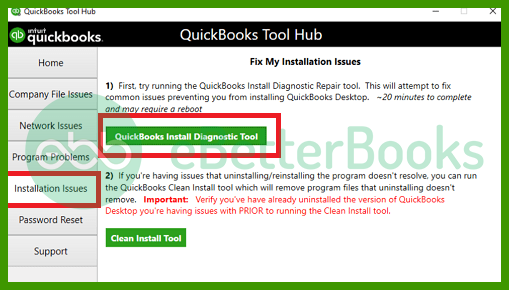
Step 2: Use QB Tool Hub to Open QuickBooks Install Diagnostic Tool

  1. Firstly, launch the QuickBooks Tool Hub from the desktop icon.
  2. After that, click on Installation Issues from the List.
  3. Select the QuickBooks Install Diagnostic Tool option.
  4. Then, choose the QBInstall tool and access it.
  5. Once you are done with the installation process, reboot the system.

Step 3: Update Windows to the Latest Version

  1. Update your windows to the latest version.
  2. After that, restart the system and check whether any issue is popping up.
  3. If QuickBooks shows any error code, then you need to launch the company file.
  4. Ensure to install the QuickBooks desktop properly if you are facing issues during QB installation.

Step 4: Resolve Windows Components Issues

You need to go through the following steps to fix Windows Components manually.

Register the MSXML DLL Files & Repair Microsoft MSXML

The following steps will apply to the 64-bit operating system:

  1. Firstly, choose the Windows Start menu and write CMD.
  2. After that, right-click on CMD to select Run as Administrator.
  3. Enter cd\Windows\syswow64 at the C: prompt.
  4. Now, write regsvr32 MSXML6.dll and choose the Enter key.
  5. Finally, install the QuickBooks desktop.

Reinstall or repair Microsoft .NET Framework

Here are the steps for Windows 10, 8.1, and 7:

  1. To start with, close all the running applications in the background.
  2. Then, choose the Windows Start menu.
  3. Open the search bar and type Control Panel.
  4. After that, click on the Programs and Features option.
  5. Select the Uninstall a Program option.
  6. Next, choose the Turn Windows Features on or off options.
  7. Finally, enable .NET Framework 3.5.

Step 5: Install QuickBooks Desktop Using Selective Startup

Here are the steps to install QuickBooks via selective startup:

  1. First of all, you need to prepare the data.
  2. After that, the system will be launched in selective startup mode.
  3. Now, you need to uninstall or install the QuickBooks software.
  4. Finally, switch QuickBooks to Normal Startup Mode.

Steps to access the system in the selective startup mode

  1. Initially, open the search box and look for MSConfig.
  2. After that, press and hold the Windows + R keys to open the MSConfig.
  3. Now, click on the selective startup from the general tab.
  4. Meanwhile, go to the services tab and click on the Hide All Microsoft Services tab.
  5. Choose the Disable All option.
  6. Next, unmark the hide all Microsoft services checkbox.
  7. Finally, choose Ok and restart the system configuration window.

Steps to Reinstall QB in the Selective Startup Mode

  1. Firstly, press the Ctrl + R keys to reinstall QB in selective startup mode.
  2. Then, write MSConfig to choose the OK tab.
  3. Choose the Selective Startup option in the general tab.
  4. Select the System Services along with the startup items.
  5. Click on the Hide All MS option and then choose the Disable All option.
  6. After that, choose the listing of services and ensure to mark the installer option.
  7. Then, you need to restart the system.
  8. Finally, the QB will be reinstalled using the clean installation procedure.

What is QuickBooks Install Diagnostic Tool?

QuickBooks Install Diagnostic Tool is a one-stop solution for numerous types of installation issues. This tool is helpful in resolving errors related to the .NET Framework, C++, and MSXML. The tool has gained popularity because many Microsoft core components are necessary for the proper functioning of QuickBooks software.

One of the best things about the QuickBooks diagnostic tool is that it automatically detects issues and fixes them. You can fix many issues just by downloading and using the QB Install Tool. Let’s start by looking for the steps to download and use the diagnostic tool.

What are the Advantages of Using the QuickBooks Install Diagnostic Tool?

The QuickBooks Install Diagnostic Tool offers several benefits to resolve installation issues.

Here are some key advantages:

AdvantageDescription
Automatic Issue DetectionThe tool automatically detects problems within QuickBooks software.
Error Code FixingIt can resolve a variety of error codes related to QuickBooks installation.
C++ Programming Error ResolutionFixes errors associated with C++ programming, ensuring smooth operation.
QuickBooks Installation IssuesResolves issues specifically related to QuickBooks installation.
.NET Framework Error ResolutionRepairs .NET Framework-related errors to ensure compatibility.
MSXML Component Damage FixIt helps repair any damage to the MSXML component.
‘QuickBooks Has Stopped Working’ IssueResolves the ‘QuickBooks has stopped working’ error for smoother operation.

Here is a list of all the error codes that you can fix with the help of the QB install tool.

QuickBooks has stopped working issue’ while accessing the software.Issues related toverifying your subscription.QuickBooksunrecoverable errors
QuickBooksError 1712QuickBooksError 15106Error Code 1935,1402
Error1722 in QuickBooksABS PDF DriverErrorsQBError 1904
Error1334QuickBooks Error1903Issues related tothe damaged C++
MSXML Damage ErrorsMS .NET Frameworkrelated issuesError1935 in QuickBooks
QuickBooksupdate error 12007UpdateError 1328QuickBooks Error15223
Get Experts Help
Call our Accounting experts to get your issue resolved right away.
Important Note: You must have the installation of the Microsoft .NET Framework and Microsoft Visual C++ package before installing the diagnostic tool. 

Final Thoughts!

The article should be fruitful regarding the QuickBooks Install Diagnostic Tool. If you are a QuickBooks user, getting acquainted with the diagnostic tool becomes mandatory. This tool is very helpful when dealing with QuickBooks error codes.

Hopefully, the above-given information will be useful for you in getting rid of this problem. But if you are still facing any kind of issues with your software and need professional assistance regarding accounting, bookkeeping & accounting software-related issues, then feel free to get in touch with us at +1-802-778-9005, or you can mail us at: support@ebetterbooks.com

Frequently Asked Questions

1. What are the three crucial Microsoft components that the Install Diagnostic Tool is specifically designed to repair?

The QuickBooks Install Diagnostic Tool is engineered to automatically detect and repair issues related to three core Microsoft components that are essential for QuickBooks to run correctly:

  • Microsoft .NET Framework: A software framework that supports the execution of many QuickBooks services and functions.
  • Microsoft MSXML: (Microsoft XML Core Services) A set of services that allows QuickBooks to handle data interactions and communications within the application.
  • Microsoft Visual C++ Redistributable Package: Necessary runtime libraries required to run programs developed with Visual C++, including parts of the QuickBooks interface and engine.

2. If the diagnostic tool reports “No errors were detected,” what is the most likely next manual step for fixing the installation?

If the diagnostic tool reports no errors, the next most likely manual step is to address corruption in a specific Microsoft component, which may require manual repair or re-registration.

  • Manual MSXML Repair: A common advanced step is to manually register the MSXML DLL files using the Command Prompt, especially on a 64-bit operating system.
    • The user must open the Command Prompt as an administrator and execute the command regsvr32 MSXML6.dll to ensure the core XML services are properly registered for QuickBooks to access data.

3. Why is using the Selective Startup mode recommended for installing QuickBooks, and what is the key difference from a normal startup?

The Selective Startup mode is recommended because it minimizes conflicts caused by non-essential background programs:

  • Conflict Prevention: Selective Startup runs Windows with only the necessary Microsoft services, disabling third-party applications (antivirus, backup utilities) that often interfere with QuickBooks installation, leading to errors like 1935 or 1402.
  • Key Difference: In Normal Startup, every application and service loads automatically, creating a competitive environment for system resources. Selective Startup isolates the installation process, ensuring that QuickBooks can access all necessary files and registry entries without being blocked.
  • Process Overview: This is achieved by using the MSConfig utility to temporarily disable all services except the required Microsoft services and the Windows Installer service.

4. Which specific Windows component must be manually enabled or repaired if the diagnostic tool fails to fix the .NET Framework error?

If the diagnostic tool does not resolve issues related to the .NET Framework, users must manually access the Windows features menu to confirm the correct versions are active:

  • Component to Check: The most frequently required version is .NET Framework 3.5, which is necessary for older QuickBooks components to execute.
  • Access Steps: The user must go to the Windows Control Panel, navigate to Programs and Features, and then select Turn Windows Features on or off to verify that the .NET Framework 3.5 and 4.8 checkboxes are marked and in the correct state (sometimes requiring a toggle-off/on sequence).

5. The article lists multiple error codes that the tool can fix. What are three categories of errors that this tool primarily resolves?

The numerous error codes that the diagnostic tool addresses generally fall into three primary categories related to program function and component failure:

  • Runtime and Component Errors: Errors tied directly to the failure of Windows components like MSXML or C++.
    • Examples: Error 1935, Error 1402, Error 1722.
  • Installation Failures: Codes indicating a problem during the initial setup or file placement due to system conflicts.
  • Program Execution Errors: Issues where QuickBooks cannot run properly once installed.
    • Examples: “QuickBooks has stopped working,” Unrecoverable Errors.

6. What are the key advantages of using the QuickBooks Install Diagnostic Tool versus manually fixing Windows components?

The QuickBooks Install Diagnostic Tool offers significant advantages over manual component repair, especially for the average user:

  • Automatic Issue Detection: The tool automatically scans for and identifies problems within the core QuickBooks and Microsoft components.
  • Time Savings: It saves considerable time by fixing issues without the user needing to search for specific file paths, registry keys, or command-line syntax.
  • Simplified C++ Repair: It resolves errors associated with C++ programming and Visual C++ packages automatically.
  • Fixes QuickBooks Has Stopped Working: It resolves common execution errors like the QuickBooks has stopped working issue.

7. Why must I restart my computer after installing the QuickBooks Tool Hub and after running the Install Diagnostic Tool?

Restarting the system is a mandatory step after installation and repair because it allows the operating system to finalize changes and reload components cleanly:

  • Finalizing Registry Changes: Installing the tool or applying fixes (especially to .NET Framework or MSXML) involves updating the Windows Registry. A restart forces Windows to load the new, fixed registry entries.
  • Releasing Locked Files: A restart ensures that any previously locked or damaged files and processes are fully released from system memory, allowing QuickBooks to access the repaired components correctly upon launch. This often resolves the “QuickBooks requires that you reboot” loop.