+1-802-778-9005
Home>>QuickBooks Errors & Their Support Troubleshooting QuickBooks Error Code 80070057 (The Parameter is Incorrect)

Submit Your Details to Continue Reading

Navigation

What is QuickBooks Error 80070057 (The Parameter Is Incorrect)? 

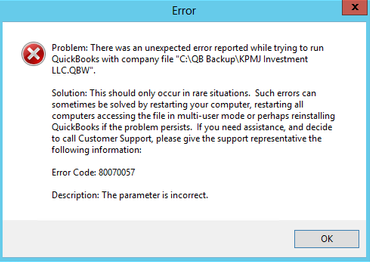
QuickBooks Error 80070057 is a runtime error that appears when the software is unable to open or access a company file. It typically occurs in multi-user environments where the company file is stored on a server or another system across a network. The error message often states: “80070057: The parameter is incorrect.”

QuickBooks Error 80070057

This error occurs when QuickBooks is unable to gain proper access to the folder where the company file is saved. In a multi-user or network environment, the system requires complete read, write, and modify permissions to interact with the file. If these permissions are not correctly assigned, QuickBooks cannot establish a secure connection to the company file.

Error 80070057 can also arise due to misconfigured hosting settings, damaged network-related files, or an invalid company file path. When these problems interrupt the connection between QuickBooks and the file location, the application cannot access the company file and generates the error message.

Common Reasons Behind QuickBooks Error 80070057

QuickBooks Error 80070057 usually occurs when the software cannot properly communicate with the company file. This is most common in multi-user or network environments where file access depends on correct permissions, hosting configuration, and system security settings. Below are the most relevant factors that can trigger this error:

  1. Invalid Network File Path: Opening the company file from an invalid or unrecognized network path can prevent QuickBooks from accessing it properly.
  2. Insufficient Folder Permissions: Missing read/write/modify access to the company file folder can block QuickBooks from opening the file. 
  3. Firewall Restrictions: Strict or misconfigured firewall settings may restrict QuickBooks from connecting to the server.
  4. Antivirus Software Interference: Security software may block or quarantine essential QuickBooks files and processes.
  5. Incorrect File Extension: A changed or corrupted company file extension can make the file unreadable to QuickBooks.
  6. Corrupted Program Files: Damaged or incomplete program files can disrupt QuickBooks functionality and trigger this error.
  7. Incomplete Installation: An interrupted installation may leave essential components improperly configured.
  8. Damaged Network Data (.ND) File: A corrupted .ND file can prevent QuickBooks from connecting to the company file in multi-user mode.
  9. Removable Storage Devices: Accessing the company file from a disconnected or unstable USB drive can cause file access errors.
  10. Hosting Misconfiguration: Incorrect multi-user hosting settings can block communication between QuickBooks and the company file.

Warning Signs of QuickBooks Error Code 80070057

QuickBooks Error 80070057 is often accompanied by noticeable system and application issues that signal problems with file access or network communication. Recognizing these warning signs early can help you diagnose the issue quickly and prevent workflow interruptions or potential data loss.

  • “The Parameter Is Incorrect” Message: An on-screen error appears when attempting to open the company file.
  • Company File Crashes: The company file closes unexpectedly, especially in multi-user mode or unstable network conditions.
  • Limited Administrative Access: Users without proper admin rights are unable to modify or delete company files.
  • Frequent System Freezing: Windows may freeze or become unresponsive while working in QuickBooks.
  • Repeated QuickBooks Crashes: The application shuts down unexpectedly during normal operations.

Different Variations of QuickBooks Error 80070057

Error Message / TypeWhat It IndicatesPossible Trigger
Unexpected Error due to Corruption or DamageQuickBooks shows an unexpected error without clearly stating “The parameter is incorrect.”Corrupted company file or damaged installation files
Insufficient Permissions to Delete FilesMessage states you don’t have sufficient permissions.Restricted folder permissions, launching from .QBW file, or antivirus blocking QuickBooks ports
Unexpected Error with Company FileError appears while opening or running a specific company file.File corruption, incompatibility, or network issues
Incorrect Parameter with Company File TypesError appears when clicking QBB, QBM, QBW, ND, or TLG files.Incorrect file association, damaged file, or access issue

How to Troubleshoot QuickBooks Error 80070057?

QuickBooks Error 80070057 can usually be resolved by identifying the root cause—whether it’s permission restrictions, hosting misconfiguration, or network-related file damage. Following a structured troubleshooting approach helps restore proper communication between QuickBooks and the company file, allowing you to regain access and continue working without disruption.

Method 1: Open Your Company File Properly

Opening the company file from within QuickBooks (instead of double-clicking the .QBW file directly) ensures proper file association and permission validation, reducing access conflicts.

Resolution Time: 2–3 minutes

Success Rate: 70%

  1. Open QuickBooks Desktop.
  2. Select the company file.
  3. Click Open.

Method 2: Update QuickBooks to the Latest Release

Updating QuickBooks installs critical patches, fixes compatibility conflicts with Windows components, and resolves known bugs that may trigger file access errors.

Estimated Resolution Time: 10–20 minutes

Success Rate: 80%

  1. Open QuickBooks Desktop and navigate to the Help menu.
  2. Choose Update QuickBooks Desktop.
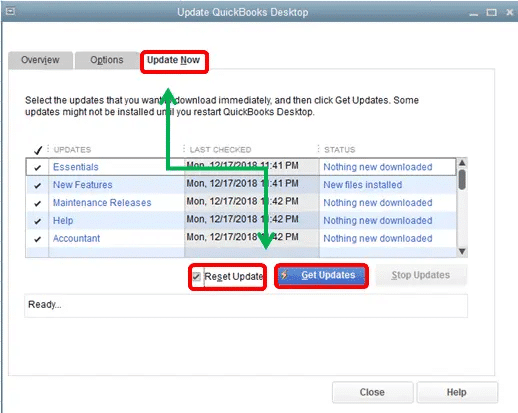
  3. Hit the Update Now tab. Tip: Tickmark the Reset Update checkbox to clear all previous update downloads.
  4. Select Get Updates to start the download.
Update QuickBooks Desktop
  1. Once done, close and reopen QuickBooks to install the update again. 

Method 3: Run QuickBooks with Admin Permissions

Running QuickBooks with administrative privileges grants full system-level permissions, eliminating access restrictions that may block the company file.

Estimated Resolution Time: 2–5 minutes

Success Rate: 75–80%

  1. Open the Windows Start menu.
  2. Enter “QuickBooks” into the search bar.
  3. You will see your results listed in the Search window.
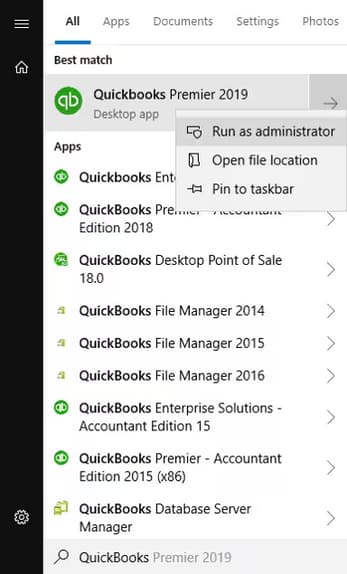
  4. Right-click on the QuickBooks version and the year you want to open.
  5. Choose Run as administrator.
Run as administrator
  1. Run the payroll update if needed.
  2. Close and reopen the QuickBooks software.
  3. If the company file did not open automatically, select the file manually, and click Open.

Method 4: Move your company file to default location

Storing the company file in QuickBooks’ default directory ensures proper path recognition, stable permissions, and improved network accessibility.

Estimated Resolution Time: 5–10 minutes

Success Rate: 75–80%

Note: If your company file is saved in a different location, move it to its default location.

  1. Close QuickBooks Desktop.
  2. Browse to the location of your company file.
  3. Right-click the company file (.QBW), and select Copy.
  4. Browse to the default location, click right and choose Paste. 

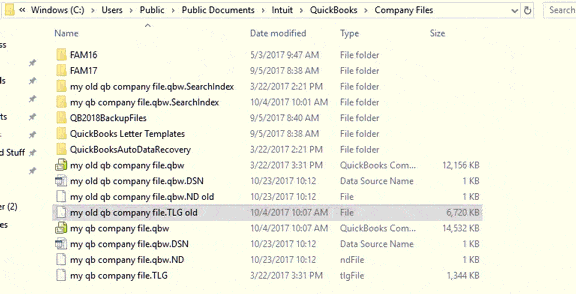
Location: C:/Users/Public/PublicDocuments/Intuit/QuickBooks/Company Files

  1. Open QuickBooks, and choose Find a company file.
  2. Select Local Drives, and search the company file name.
  3. Choose the correct company file, and click Open.

Method 5: Run the QuickBooks File Doctor

QuickBooks File Doctor automatically detects and repairs company file corruption, network issues, and connectivity problems that commonly cause Error 80070057.

Estimated Resolution Time: 15–25 minutes

Success Rate: 85–90%

Step 1: Download & Install the QuickBooks Tool Hub 

The QuickBooks Tool Hub helps to fix common errors. You’ll need to close QuickBooks to use the tool hub. For the best experience, we recommend you use Tool Hub on Windows 10, 64-bit.

  1. Close QuickBooks.
  2. Download and install the most recent QuickBooks Tool Hub version (1.6. 0.8). 
  3. Save the file somewhere you can easily find it such as your Downloads folder or your Windows desktop. 

Note: To find out which tool hub version you have, select the Home tab and the version will be on the bottom.

  1. Open the downloaded file QuickBooksToolHub.exe to start the installation.
  2. Follow the on-screen steps to install and agree to the terms and conditions.
  3. When the installation finishes, click twice on your Windows desktop icon to open the tool hub.
QuickBooks-Tool-Hub

Note: If you are unable to find the icon, do a search in Windows for QuickBooks Tool Hub and select the program.
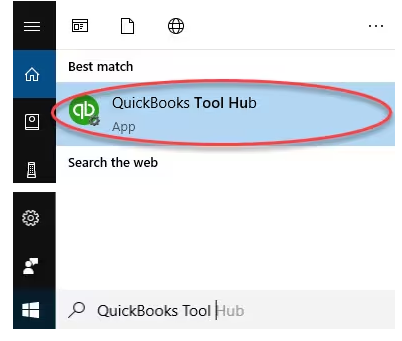
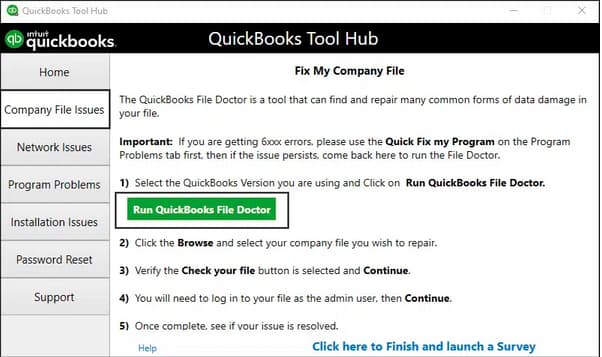
QuickBooks Tool Hub

Step 2: Run QuickBooks File Doctor

QuickBooks File Doctor
  1. Select Company File Issues from the tool hub.
  2. Choose Run QuickBooks File Doctor. It can take up to one minute for the file doctor to open.

Note: Look for QuickBooks Desktop File Doc and try to open it manually if the QuickBooks File Doctor doesn’t open.

  1. In QuickBooks File Doctor, select your company file from the dropdown menu. Click Browse in case you don’t see your file and search to find your file.
  2. Click Check your file (middle option only) and select Continue.
  3. Enter your QuickBooks admin password and click Next.

Depending on file size, the scan can take 10 to 15 minutes. It may show as unsuccessful even if the problem is fixed. Once finished, reopen QuickBooks and your company file.

Note: When QuickBooks File Doctor doesn’t resolve the issue, proceed by repairing data damage on your QuickBooks Desktop company file.g

Method 6: Free up Disk Space 

Freeing up disk space removes temporary and corrupted system files that may interfere with QuickBooks performance and file operations.

Estimated Resolution Time: 10–15 minutes

Success Rate: 60%

  1. Type disk cleanup in the search box on the taskbar and select it from the results.
  2. Choose the drive you want to clean up files for, and click OK.
  3. Select the check box next to the type of files you want to delete. 

Note: To view a description of each type of file, choose the name.

  1. By default, Downloaded Program Files, Temporary Internet Files, and Thumbnails are selected. Clear these check boxes if you don’t want to delete them.
  2. To free up more space, select Clean up system files, choose a drive, and click OK.
  3. Once the calculation is complete, select the system file types you want to delete. Disk Cleanup may take a few moments to calculate the available space.

Note: If it’s been less than 10 days since you upgraded Windows, your previous version will appear as a system file you can delete. Deleting it will remove the Windows.old folder, which is required to roll back to the previous Windows version. When you delete your previous Windows version, this action can’t be undone and you won’t be able to go back to your old version. 

  1. After selecting the types of files you want to delete, click OK, and choose Delete Files in the confirmation window to start the cleanup. 

Method 7: Check the System Date & Time Settings 

Correct system date and time settings ensure proper Windows authentication and prevent validation conflicts that may block file access.

Estimated Resolution Time: 3–5 minutes

Success Rate: 40%

  1. Click Start and select Settings  > Time & language  > Date & time.
  2. Or, select the following Date & time shortcut:
Date & time shortcut
  1. Under the Date & time window:
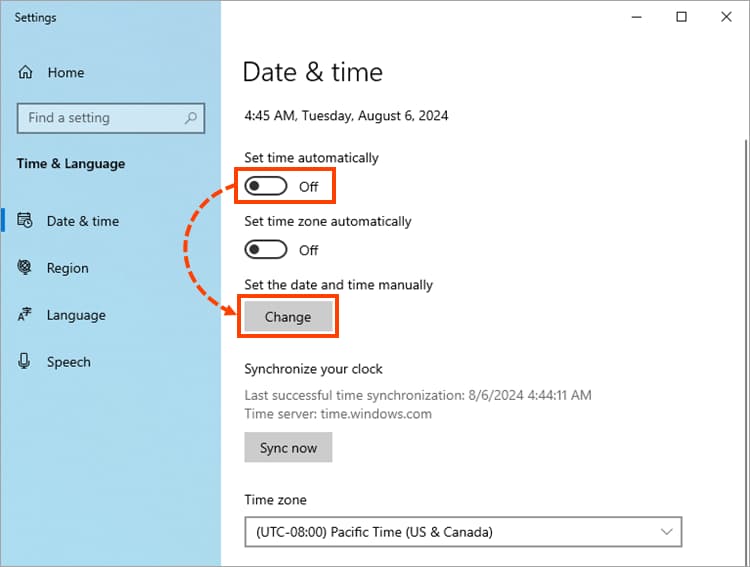
  • To set the date and time automatically, ensure the “Set time automatically” option is turned On.
Date & time window
  • To set the date and time manually, turn off the “Set time automatically” option, and choose the Change button under “Set the date and time manually.” 
Set the date and time manually
  • When the Change Date and Time window opens, type the correct date and time, and click Change to save your settings.
Change Date and Time window

Method 8: Run the DISM & System File Checker Tool

DISM and SFC repair corrupted or missing Windows system files that QuickBooks depends on, restoring system stability and resolving deeper OS-level issues.

Estimated Resolution Time: 20–30 minutes

Success Rate: 70%

Step 1: Run the DISM Scan

DISM provides the files required to repair your corrupted files. You should run DISM prior to running the System File Checker. To do this:

  1. Open an elevated command prompt.
  • Click the Start button and type cmd in the Search box.
  • From the search results, right-click Command Prompt, and choose Run as administrator.
  • When prompted for confirmation or an administrator password, type the password, or select Allow.
  1. Under the Command Prompt window, type the following command and click Enter.  It may take several minutes for the command operation to be completed.

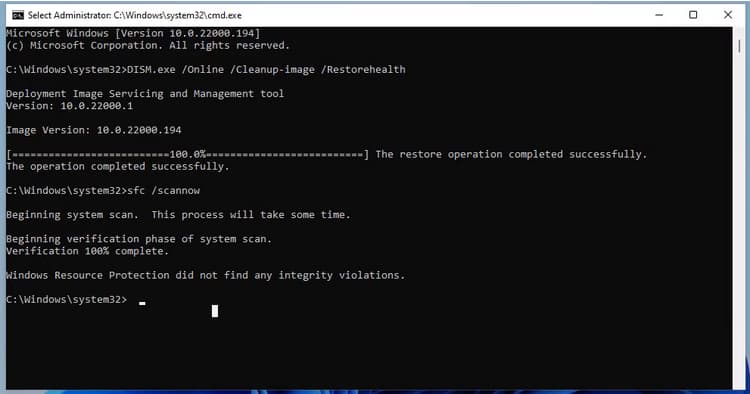
DISM.exe /Online /Cleanup-image /Restorehealth
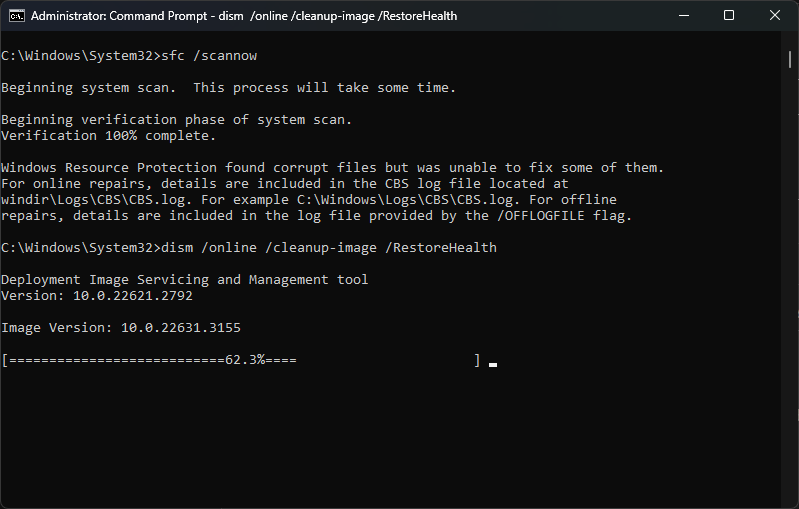
Command Prompt window

Step 2: Run the System File Checker 

Run the System File Checker
  1. Hold and press the Windows + X key and enter cmd into the search box.
  2. Right-click Command Prompt from the search result and select Run as Administrator.
  3. Type the following command and click the Enter key under the Command Prompt window:
Enter key under the Command Prompt
  1. After you receive the message “The operation completed successfully,” type sfc /scannow in the command prompt window (ensure there is a space between sfc and /), and click Enter.
type sfc scannow in the command prompt window
  1. The SFC tool will now detect and scan your system files for issues and replace any corrupted files if necessary. Wait for the verification process to complete.
  2. When the message “Verification 100% complete” appears, type exit and click Enter.
  3. Once done, restart your system at the end.

Method 9: Manually Resolve Error 800070057

Renaming the damaged .ND file and rescanning via Database Server Manager rebuilds network configuration files and restores proper multi-user connectivity.

Estimated Resolution Time: 10–15 minutes

Success Rate: 85–90%

Step 1: Rename the .ND file

  1. Browse to the location of your company file.
  2. Search for the corresponding .ND file of your company file.

Example: MyCompanyFileName.qbw.nd

  1. Right-click the .ND file, and choose Rename.
  2. Enter .old at the end of the file name.

Example: MyCompanyFileName.qbw.nd.old
OLD, company_file

Step 2: Run the QuickBooks Database Server Manager on your server

  1. Close QuickBooks.
  2. Download and install the QuickBooks Tool Hub if you haven’t yet. 
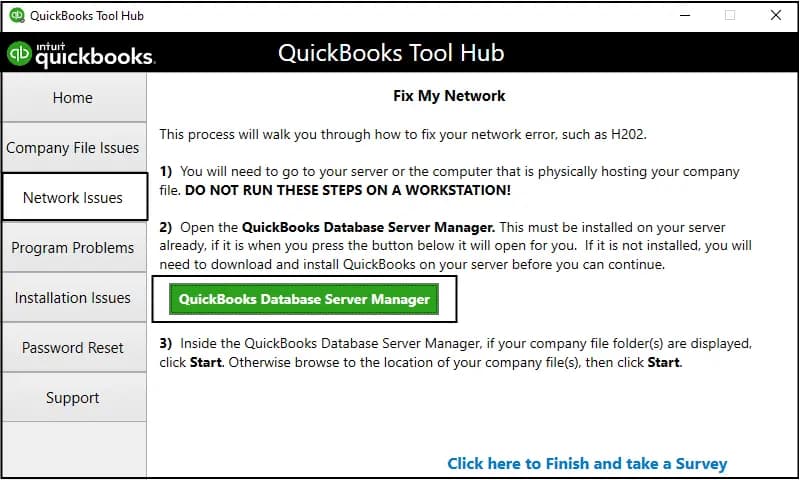
  3. Select Network Issues in the tool hub.
  4. Choose QuickBooks Database Server Manager. If QuickBooks isn’t installed on your server, you’ll be prompted to install it.
QuickBooks Database Server Manager
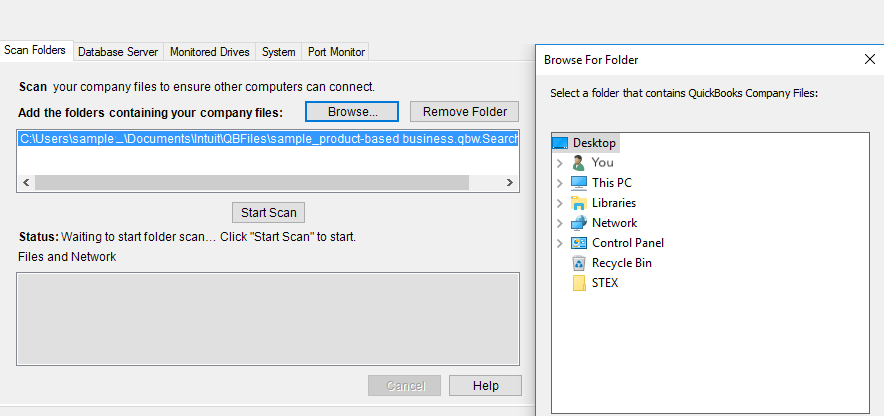
  1. Inside the QuickBooks Database Server Manager, select Start Scan if your company file folder(s) are displayed.  If they aren’t, Browse to the location of your company file and click Start Scan.
the location of your company file and click Start Scan
  1. Click Close.

Note: If you’re using BitDefender, ensure the QuickBooks folder is added to the exclusion list.

Conclusion!

QuickBooks Error 80070057 (The Parameter Is Incorrect) primarily occurs when the software is unable to access the company file due to permission restrictions, network misconfigurations, or damaged program components. Since the error is commonly linked to multi-user environments and server-stored files, ensuring proper folder permissions, correct hosting settings, and stable network connectivity is essential.

By identifying the specific cause whether it’s a corrupted .ND file, antivirus interference, firewall restrictions, or an invalid file path, you can apply the appropriate troubleshooting steps to restore access quickly. Keeping QuickBooks updated, ensuring proper folder permissions, and correctly configuring security settings can help prevent this error from recurring.

FAQs:

Q1. Why does running QuickBooks as an administrator often resolve Error 80070057, and is it a long term fix?

Running QuickBooks Desktop as an administrator often resolves Error 80070057 because the error is fundamentally about permission restrictions preventing the program from fully accessing the company file.

  • When you run the application as an administrator, you temporarily bypass typical Windows User Account Control restrictions and grant QuickBooks the highest level of read and write access. This allows the program to authenticate the file and make necessary internal modifications, such as updating configuration files.
  • Is it a long term fix? Not necessarily. It serves as a quick workaround and a diagnostic tool. If running as administrator fixes the issue, the root cause is confirmed to be insufficient folder or file permissions for the standard user account (often the Windows service user QBDataServiceUserXX). The long term solution is to adjust the security properties of the company file folder to grant the necessary “Full Control” permissions to the correct service user.

Q2. In a multi-user environment, what exactly is the .ND file, and why must I rename it to fix this error?

The .ND (Network Data) file is a crucial configuration file that allows QuickBooks Desktop to access a company file (.QBW) over a network, especially in multi-user mode.

  • What it contains: The .ND file stores essential network information, including the IP address and port number of the server hosting the company file, and maintains the current status of network file access.
  • Why rename it? Error 80070057 often occurs when the existing .ND file is damaged, corrupted, or outdated, causing the workstation to fail the network connection test. Renaming the file (e.g., to filename.qbw.nd.old) effectively removes the damaged configuration. The next time the QuickBooks Database Server Manager runs a scan, it forces the automatic creation of a new, clean .ND file, resolving the communication failure.

Q3. How do I manually verify if my company file folder has the correct Windows permissions before resorting to complex tools?

You can test for insufficient read or write permissions directly using a simple document creation test in the folder where the company file is saved. This step confirms the error is permission-related before moving the file or running major tools.

  • Test Procedure:
    1. Open Microsoft Notepad or another text application.
    2. Type a simple word or phrase into the document.
    3. Attempt to Save the file directly into the specific network folder where your company file (.QBW) is located.
  • Result Interpretation:
    • If the file saves without issues: The folder has correct Write permissions for your user account.
    • If you receive an error (e.g., “Access is denied” or “You do not have permission”): The folder permissions are restricted. This immediately validates that Error 80070057 is likely caused by insufficient access rights, and you must then adjust the folder’s security settings.

Q4. What specific action must I take inside the QuickBooks Database Server Manager to fix the error?

When troubleshooting 80070057, you must use the QuickBooks Database Server Manager (QDSM), installed on the server or host computer, to perform a rescan of the company file folder.

  • Action Required:
    1. Open the QDSM.
    2. Navigate to the Scan Folders tab.
    3. If your company file folder is listed, select Start Scan.
    4. If the folder is not listed, use the Add Folder option to manually browse to the folder containing the company file (.QBW), then select Start Scan.
  • The Fix: The scan process automatically reconfigures the Network Data (.ND) file and adjusts Windows firewall permissions for the specific folder being scanned. This re-establishes stable, authorized communication between the server and the QuickBooks processes, resolving the “parameter incorrect” error.

Q5. If BitDefender or another antivirus is causing Error 80070057, which specific files or paths should I exclude from scanning?

When security software like BitDefender is overly restrictive, it blocks essential QuickBooks processes, causing the error. To grant full access, you must set an exclusion for the entire QuickBooks company file folder and the main QuickBooks program files.

  • Recommended Exclusions:
    1. The Company File Folder Path: Exclude the folder containing the QBW file, typically: C:\Users\Public\Public Documents\Intuit\QuickBooks\Company Files.
    2. The QuickBooks Executables: Exclude the path to the main QuickBooks program files, typically: C:\Program Files\Intuit\QuickBooks [Year].
    3. Essential Executables: If granular exclusion is required, allow the following core executables to communicate:
      • QBW32.exe
      • QBDBMgrN.exe (Database Server Manager service)
      • QBCFMonitorService.exe (QuickBooks Client File Monitor Service)

Q6. What are the common QuickBooks file extensions, and which ones are most likely to trigger the 80070057 error if used incorrectly?

The error can be triggered when the application is asked to open a file type in a manner that requires authentication it cannot complete (e.g., trying to restore a backup without using the proper restoration command).

  • Common File Extensions:
    • .QBW (The active working company file)
    • .QBB (A full backup file)
    • .QBM (A portable company file)
    • .QBX (Accountant’s Transfer File)
  • High Risk Scenarios for Error 80070057:
    1. Opening .QBM or .QBB directly: Trying to open a portable (.QBM) or backup (.QBB) file directly using a double-click instead of the File > Open or Restore Company command can trigger the error. The application needs to process the restoration before accessing the file, which fails if the direct open method is used.
    2. Mismatched or Corrupted Extension: If the extension of the working file (.QBW) is accidentally changed or corrupted, QuickBooks cannot recognize it as a valid company file and displays the “parameter is incorrect” error.

Q7. When moving the company file, what is the default Windows path recommended by Intuit?

When you move a company file to resolve permission issues, the recommended and safest location to ensure the least resistance from Windows security settings is the Public Shared folder created by Intuit during installation.

  • Default Location (Recommended Path):
    • C:\Users\Public\Public Documents\Intuit\QuickBooks\Company Files
  • Rationale: This specific folder path is configured during installation to grant the necessary read/write/modify permissions for all users and the QBDataServiceUserXX service account. Storing the file here bypasses restrictions that occur if the file is stored on a desktop, the C: drive root, or other personal, restricted folders, directly addressing a primary cause of Error 80070057.