Excerpt:
QuickBooks Error H303 occurs when a system fails to access company files in multi-user mode, typically due to improper network settings, firewall restrictions, or corrupted files. This issue disrupts seamless workflow. Solutions include using the File Doctor Tool, adjusting firewall settings, changing file location, and reconfiguring hosting settings. Proactively addressing these errors ensures uninterrupted access to essential files and improves QuickBooks performance for business efficiency.
 Add As A Preferred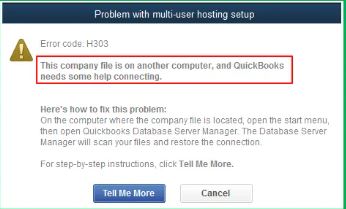
Fix QuickBooks Error H303 by:
QuickBooks Error H303 appears with the message ‘This company file is on another computer, and QuickBooks needs some help connecting.’ The Intuit QuickBooks Community confirms H303 means the QuickBooks multi-user hosting configuration is wrong – specifically that the computer holding the company file is not properly set up to share it with other computers on the network. Every workstation on the network that tries to open the file in multi-user mode receives the same H303 error until the server’s hosting configuration is corrected.
The Intuit QuickBooks Community identifies the single most common cause of H303: the server computer has Host Multi-User Access turned OFF. The server holds the company file and should be the only computer with hosting turned ON – but QuickBooks Desktop does not turn hosting on automatically after installation. A server with hosting off produces H303 on every workstation simultaneously, and the fix takes under two minutes: File > Utilities > Host Multi-User Access on the server.
The Intuit QuickBooks Community also confirms a network diagnostic step: running ipconfig on the server and then pinging the server by name from each workstation. A failed ping by name with a successful ping by IP address confirms DNS name resolution is broken – the workstations cannot find the server by its computer name even though they can reach it by address. No QuickBooks tool resolves a DNS problem. Fixing the hosts file on each workstation immediately restores name resolution without involving the IT administrator.
The H-series errors in QuickBooks – H101, H202, H303, H505 – all relate to multi-user access but each points to a different specific part of the hosting setup that is wrong. The Intuit QuickBooks Community confirms: H303 and H505 both indicate that one or more workstations are incorrectly set to act as the server.
H202 indicates the workstation cannot reach the server at all. H303 specifically means the computer the user is on has hosting turned on when it should not, or the server that should be hosting has hosting turned off.
A multi-user QuickBooks setup requires exactly one computer – the server – to have Host Multi-User Access turned ON. Every other computer on the network – the workstations – must have it turned OFF.
The Intuit QuickBooks Community confirms: if any workstation has hosting turned on, that workstation attempts to become the host itself rather than connecting to the server. Two computers trying to host the same file simultaneously creates the conflict that produces H303. The Intuit QuickBooks Community’s own H303 resolution guide makes correcting hosting settings Step 1 – ahead of File Doctor and ahead of firewall fixes.
The QBCFMonitorService is a second Windows background service that runs alongside the QuickBooksDBXX database service on the server. Both must be running for multi-user access to work.
The Intuit QuickBooks Community confirms QBCFMonitorService monitors the connection between QuickBooks Desktop on the server and the QuickBooks Database Server Manager – if it stops, workstations lose the ability to communicate with the file even though the database service continues running. QBCFMonitorService is a separate required service with its own Automatic startup and Recovery tab settings.
When QuickBooks Error H303 occurs (typically when opening a company file in multi-user mode), users typically see one of these messages:
H303 belongs to the H-series of multi-user networking errors and is triggered when QuickBooks Database Server Manager isn’t running correctly on the host machine, or when firewall/hosting settings block the connection, most commonly appearing right after a new workstation is added to an existing multi-user setup — the same family covered in your H202 reference document.
Confirmed via Intuit’s own QuickBooks File Doctor support article, which explicitly lists H101, H202, H303, and H505 together.
Run the network diagnostic first. On the server, press Windows+R, type cmd, press Enter, type ipconfig and press Enter. Note the IPv4 Address. On each affected workstation, open Command Prompt and type ping [server computer name].
If the ping fails by name but succeeds when you type ping [server IP address], the root cause is DNS name resolution – fix the hosts file before applying any QuickBooks setting change. If both pings succeed, the network path is working and the cause is in the QuickBooks hosting or service configuration.
| When H303 Appears | Why This Is Happening | Recommended Fix |
|---|---|---|
| H303 on all workstations immediately – never worked in multi-user mode on this setup | Server has Host Multi-User Access turned OFF – it is not configured to be the host | On the server: open QuickBooks > File > Utilities > if the menu shows Host Multi-User Access, click it to turn hosting ON. If it shows Stop Hosting Multi-User Access, hosting is already on – move to the next cause |
| H303 on all workstations immediately – worked before but stopped after a change | One or more workstations have hosting turned ON and are conflicting with the server | On each workstation: open QuickBooks > File > Utilities > if menu shows Stop Hosting Multi-User Access, click it to turn hosting OFF. Leave workstations where the menu shows Host Multi-User Access (hosting already off) |
| H303 on all workstations after the server was restarted overnight | QBCFMonitorService or QuickBooksDBXX service not running after restart – startup type set to Manual | On the server: Windows+R > services.msc > find QuickBooksDB2026 and QBCFMonitorService > right-click each > Properties > Startup Type: Automatic > Recovery tab: all failures set to Restart the Service > click Start if not running |
| H303 on all workstations and ping by server computer name fails – ping by IP address succeeds | DNS name resolution broken – workstations cannot find the server by name even though the network connection is physically working | On each affected workstation: get server IP from ipconfig on the server > edit C:\Windows\System32\drivers\etc\hosts > add line: [server IP] [server name] > save. This bypasses DNS and restores name resolution immediately |
| H303 after company file was moved to a new folder on the server | New folder is not shared with the network and/or QBDataServiceUserXX does not have Full Control of it | Right-click new folder > Properties > Sharing tab > Share > add QBDataServiceUser[version] with Full Control > Share > OK. Then Security tab > Edit > add QBDataServiceUser[version] > Full Control > Apply. Rescan in Database Server Manager |
| H303 on specific workstations only – other workstations connect without error | Firewall on those specific workstations or on the server is blocking QuickBooks ports for those machines | Add Windows Firewall inbound and outbound exceptions for ports 8019 and the dynamic port shown in Database Server Manager Port Monitor tab. Add QBDBMgrN.exe and QBCFMonitorService.exe to the antivirus exceptions on the server |
| H303 and .ND file in company file folder is missing or dated before the current setup | The .ND file is corrupted or outdated – workstations reading it are directed to a wrong or missing path | Delete the existing .ND file from the company file folder. Open Database Server Manager on the server > Browse to the company file folder > Start Scan. The scan creates a fresh .ND file with the correct current server path |
Host Multi-User Access is a QuickBooks software setting – turned on or off through File > Utilities inside QuickBooks Desktop. It tells QuickBooks on that specific computer whether to act as the file host for the network. The QuickBooks Database Server Manager is a separate Windows background program – installed on the server – that manages the actual file sharing on the network.
The Intuit QuickBooks Community confirms both must be correctly configured: hosting must be ON in QuickBooks on the server AND the Database Server Manager must be installed and scanning the correct folder. Either one alone is not sufficient for multi-user mode to work.
QBCFMonitorService is the QuickBooks Communication Framework Monitor Service – a Windows background service that manages the live communication channel between QuickBooks Desktop on the server and the QuickBooks Database Server Manager.
The Intuit QuickBooks Community confirms: if QBCFMonitorService stops while the server is running, workstations lose their active connection to the company file even though the QuickBooksDBXX database service continues running. Setting both services to Automatic startup with Restart recovery options through services.msc ensures that a momentary service stop does not take down multi-user access for everyone.
The hosts file is a plain text file on every Windows computer at C:\Windows\System32\drivers\etc\hosts. Windows checks this file before looking up a computer name on the network. Adding a line that maps the server’s IP address to its computer name – for example: 192.168.1.10 ACCOUNTINGSERVER – tells Windows to use that address for any request involving that computer name, without relying on DNS.
The Intuit QuickBooks Community confirms this fix works immediately after saving the file and does not require a computer restart. The hosts file is fully reversible – removing the added line returns the system to its original DNS-based lookup.
Solutions are organized by confirmed cause. Start with Level 1 – the hosting settings check resolves the majority of H303 cases in under five minutes. Run the network ping test before Level 1 to confirm the network path is working. Advance to Level 2 and Level 3 only after confirming Level 1 fixes have been applied correctly on every computer.
| Level 1 – Hosting Settings, Services, and Database Server Manager Scan |
These solutions carry zero risk to company data and address the three most common confirmed causes of H303. Run them in the order shown – correct hosting settings first, then services, then the Database Server Manager scan.
| Skill Level | Risk Level | Success Probability | Approximate Time |
|---|---|---|---|
| Beginner | None | 80% – Resolves H303 immediately when a hosting misconfiguration is the confirmed cause | 10 minutes |
| Risk ExplanationTurning hosting on or off through File > Utilities changes only the multi-user configuration setting for that computer. No company file data is modified. The change takes effect immediately and can be reversed by following the same steps in the opposite direction. | Solution ExplanationThe Intuit QuickBooks Community confirms incorrect hosting settings – hosting off on the server or hosting on at a workstation – as the primary cause of H303. Both errors produce identical H303 symptoms and must both be checked. The Intuit QuickBooks Community states clearly: H303 appears when one or more workstations are set to act as the server. Correcting hosting settings on every computer in the network takes under ten minutes and resolves H303 without any tool or reinstall. | ||
Steps on Every Workstation:
1. Open QuickBooks on each workstation – do not open the company file. Click the File menu at the top. Select Utilities from the dropdown. Look at the submenu carefully. If the submenu shows Stop Hosting Multi-User Access, that workstation has hosting incorrectly turned on – click it to turn hosting off.
If the submenu shows Host Multi-User Access (without the word Stop), hosting is already off on this workstation – leave it and move to the next computer.
Steps on the Server:
2. Open QuickBooks on the server computer. Click the File menu. Select Utilities. If the submenu shows Host Multi-User Access, click it – this turns hosting ON. The server is now designated as the host. If the submenu shows Stop Hosting Multi-User Access, hosting is already on – leave it.
3. After correcting all computers, go to one workstation. Open QuickBooks. Go to File > Open or Restore Company > Open a company file. Browse to the server path. Open the file. Click Switch to Multi-User when prompted. Confirm H303 no longer appears. Test from each workstation.
| Skill Level | Risk Level | Success Probability | Approximate Time |
|---|---|---|---|
| Beginner | None | 85% – Resolves H303 caused by stopped services or services that drop after a server restart | 10 minutes |
| Risk ExplanationStarting a Windows service and changing its startup type carries zero risk to company data. The Recovery tab setting only affects what Windows does if the service stops unexpectedly – it does not change how the service operates when it is running normally. | Solution ExplanationThe Intuit QuickBooks Community confirms both QuickBooksDBXX and QBCFMonitorService must be running simultaneously on the server for multi-user access to work. Either service stopping produces H303 for all workstations. Setting both to Automatic startup eliminates the recurring H303 that appears every morning after overnight server restarts. Setting the Recovery tab to Restart the Service for all failure types means a momentary service drop self-corrects without any user action. | ||
Steps to Implement Solution 1.2:
1. On the server, press Windows+R. Type services.msc and press Enter. The Services window opens listing all Windows background services. Scroll to find the QuickBooks database service – its name includes the year version number. QuickBooksDB34 for QuickBooks 2024, QuickBooksDB35 for 2025, QuickBooksDB36 for 2026.
2. Right-click the QuickBooksDB service for the correct year. Select Properties. Change the Startup Type dropdown from Manual to Automatic. Click the Recovery tab. Set First failure, Second failure, and Subsequent failures all to Restart the Service. Click Apply. Check the Service status at the top – if it shows Stopped, click Start. Click OK.
3. Scroll through the Services list to find QBCFMonitorService. Right-click it and select Properties. Repeat the exact same steps: Startup Type to Automatic, all Recovery tab options to Restart the Service, Start if stopped, Apply, OK. After both services show Running, test multi-user access from each workstation.
| Skill Level | Risk Level | Success Probability | Approximate Time |
|---|---|---|---|
| Beginner | None | 75% – Resolves H303 caused by an outdated or corrupted .ND file or missing firewall permissions | 10 minutes |
| Risk ExplanationDeleting the .ND file removes only the network path configuration file – no transaction data, no company records, and no employee information is stored in it. The Database Server Manager scan creates a new .ND file automatically. The scan also reconfigures Windows Firewall permissions for QuickBooks automatically. | Solution ExplanationThe Intuit QuickBooks Community confirms the .ND file (Network Descriptor file) stored next to the company file tells every workstation how to reach the server. A corrupted or outdated .ND file causes H303 on all workstations simultaneously. Deleting the .ND file and running a fresh Database Server Manager scan rebuilds it with the current server path and port information. The scan also reconfigures firewall rules for QuickBooks automatically – resolving many firewall-caused H303 cases without manual firewall rule creation. | ||
Steps to Implement Solution 1.3:
1. On the server, open File Explorer and navigate to the folder where the company file is stored. Look for a file with the same name as the company file but ending in .ND – for example MyCompany.QBW.ND. Right-click it and select Delete. Confirm the deletion.
2. Open the QuickBooks Tool Hub on the server. Click Network Issues. Click QuickBooks Database Server Manager. Click Browse and navigate to the folder containing the company file. Select the folder and click OK. Click Start Scan. The scan creates a new .ND file and reconfigures firewall permissions.
3. After the scan confirms completion, click Close. On each workstation, open QuickBooks and attempt to open the company file in Multi-User mode through File > Open or Restore Company. Confirm H303 no longer appears on any workstation.
| Level 2 – DNS Fix, Folder Sharing Permissions, and File Doctor |
Use these solutions after Level 1 is complete and H303 still appears on some or all workstations. They address DNS name resolution, company file folder sharing permissions, and company file damage.
| Skill Level | Risk Level | Success Probability | Approximate Time |
|---|---|---|---|
| Intermediate | Low – edits to the hosts file and folder permissions are both fully reversible | 80% for DNS-specific and new-folder H303 cases | 20 minutes |
| Risk ExplanationAdding a line to the hosts file creates a static name-to-address mapping for the server only. It does not affect DNS for any other computer or any other network name. Folder sharing permissions apply only to the company file folder – no other folders or system settings are changed. Both changes are fully reversible. | Solution ExplanationThe Intuit QuickBooks Community confirms a failed ping by server name with a successful ping by IP address means DNS name resolution is broken for that workstation – a condition that no QuickBooks tool can repair. Adding the server IP and name to the hosts file bypasses DNS immediately. For H303 after moving the company file, the Intuit QuickBooks Community confirms the new folder must have both Windows network sharing enabled and QBDataServiceUserXX granted Full Control before Database Server Manager can serve the file. | ||
Steps – Fix DNS With the Hosts File:
1. On the server, press Windows+R, type cmd, press Enter. Type ipconfig and press Enter. Find the IPv4 Address line and write down the number shown – for example 192.168.1.15. This is the server’s address on the local network.
2. On each affected workstation, press Windows+R. Type notepad C:\Windows\System32\drivers\etc\hosts and press Enter. Right-click Notepad in the taskbar and select Run as Administrator if a permission warning appears. The hosts file opens. Scroll to the very bottom of the file.
On a new blank line, type the server IP address, press the Tab key once, then type the server computer name exactly as shown in the Windows system name (found at Control Panel > System > Computer name on the server). Press Ctrl+S to save. Close Notepad. Test multi-user access.
Steps – Set Folder Sharing and Permissions:
3. On the server, right-click the company file folder in File Explorer. Select Properties. Click the Sharing tab. Click Share. In the text field, type QBDataServiceUser and the version number matching the installed QuickBooks year. Click Add.
Set the permission level to Full Control. Click Share, then Done. Click the Security tab. Click Edit. Click Add. Type the same QBDataServiceUser account name. Click Check Names, then OK. Check the Full Control checkbox under Allow. Click Apply, then OK. Rerun the Database Server Manager scan after applying both changes.
Contact Intuit QuickBooks Support in the following situations. These scenarios require Intuit or an IT specialist to act beyond what QuickBooks self-service tools can address.
Provide the exact time H303 begins each day – this helps narrow down which scheduled task or policy is interfering.
If File Doctor cannot repair the file, the company file itself has data damage contributing to H303. Contact Intuit Data Services. Provide both the damaged company file and the most recent backup that predates the H303 issue.
Contact the network administrator and provide ports 8019 and the dynamic port from Database Server Manager > Port Monitor. These ports must be allowed through the VPN for QuickBooks multi-user access to work remotely.
Contact Intuit support for instructions on updating the Database Server Manager to the matching version without reinstalling the full QuickBooks Desktop on the server.
Preventing QuickBooks Error H303 requires four consistent habits: verifying hosting settings on every computer immediately after any QuickBooks update, setting both QuickBooksDBXX and QBCFMonitorService to Automatic startup with Restart recovery options, running a Database Server Manager scan any time the company file is moved or renamed, and confirming QBDataServiceUserXX folder permissions after any Windows Update that may have reset them.
The Intuit QuickBooks Community confirms QuickBooks Desktop updates occasionally reset hosting settings – re-enabling Host Multi-User Access on workstations that had it correctly turned off.
Checking File > Utilities on every workstation after each QuickBooks update – and confirming none show Stop Hosting Multi-User Access – takes under two minutes per computer and prevents the most common single-event trigger of H303 from recurring after routine software maintenance.
The Intuit QuickBooks Community confirms both QuickBooksDBXX and QBCFMonitorService stopping after a server restart is the most common cause of recurring daily H303.
Setting both to Automatic with Restart the Service recovery options in services.msc immediately after QuickBooks is installed or after the server is rebuilt eliminates this cause permanently. The five minutes spent setting these options after installation prevents hours of troubleshooting every time the server is restarted.
Moving or renaming the company file makes the existing .ND file immediately outdated – every workstation reading the old .ND file is directed to a path that no longer exists. Running a Database Server Manager scan immediately after any file move or rename rebuilds the .ND file with the correct new path before any workstation attempts a connection.
This scan also reconfigures firewall permissions automatically – preventing the H303 that would otherwise appear the moment the first workstation tries to open the file from the new location.
Windows Updates that modify security policies occasionally reset folder permissions – removing the Full Control access that QBDataServiceUserXX requires on the company file folder. Checking the folder’s Security tab after each major Windows Update confirms the permission is still in place.
Finding the QBDataServiceUser account removed from the Security tab and re-adding it with Full Control followed by a Database Server Manager rescan restores multi-user access before any user reports seeing H303.
Fix QuickBooks Error H303 by running a ping test from the affected workstations to the server first – a failed ping by name identifies a DNS problem that must be fixed before any QuickBooks setting change applies.
After confirming the network path works, correct hosting settings on every computer: File > Utilities > Host Multi-User Access must be ON only on the server and OFF on every workstation. Both QuickBooksDBXX and QBCFMonitorService must be running on the server with Automatic startup and Restart recovery settings. Delete the .ND file and run a Database Server Manager scan to rebuild it.
The ipconfig and ping network diagnostic is the first step, the QBCFMonitorService Recovery tab settings as a named separate fix, the company file folder sharing permission requirements for QBDataServiceUserXX, and the hosts file as the specific fix for DNS name resolution failures.
Each of these addresses a confirmed cause of H303 that remains after the standard File Doctor and Database Server Manager steps are applied – and each produces an H303 that looks identical to a hosting or firewall problem but does not respond to hosting or firewall fixes.
Preventing H303 requires four habits: verify hosting settings after every QuickBooks update, set both services to Automatic startup with Restart recovery immediately after installation, run a Database Server Manager scan after every file move or rename, and confirm QBDataServiceUserXX folder permissions after Windows Updates. These habits address every confirmed recurring cause of QuickBooks Error H303 before it can block multi-user access.