Excerpt:
Maintaining QuickBooks Desktop requires regular updates, which are essential for security, regulatory compliance, and system stability, as opposed to paid upgrades for new versions. Users can easily verify their current software release using the F2 key on Windows or Command + 1 on Mac. The process for updating is split into manual and automatic methods, but troubleshooting is often necessary due to conflicts. When updates fail, the user must address common technical blockers by ensuring QuickBooks is run with administrator access and by manually ending specific background processes such as QBW32.exe and qbupdate.exe in the Windows Task Manager. For businesses using multi-user mode, updates must be carefully scheduled across all workstations to prevent version mismatches that block access to the company file. Furthermore, users should understand that updates are mandatory for correct payroll and tax form generation, and for severe installation errors, the official QuickBooks Tool Hub should be used to repair underlying Windows components.
 Add As A Preferred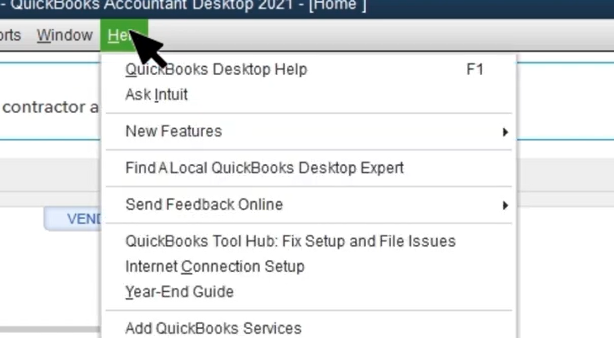
Highlights (Key Facts & Solutions)
To check the version of the QuickBooks desktop you are using, follow these steps:
| FAQs: How can I check the version of the QuickBooks Desktop I am using? |
Step 1: Lunch QuickBooks Desktop.
Step 2: Press F2 (or Ctrl + 1) to launch the Product Information window.
From the product information window, the user can check the current version and release.
The following are the latest releases available for the QuickBooks Desktop versions:
Step 1: Launch QuickBooks Desktop.
Step 2: Press Command + 1 to launch the Product Information window.

From the product information window, the user can check the current version and release.
The following are the latest releases available for the QuickBooks Desktop versions:
This process will help you determine whether your QuickBooks Desktop is running the latest version or if an update is needed.
The users can update QuickBooks Desktop manually or set it to update automatically whenever a new update is available.
To manually update QuickBooks, follow the steps below:
Step 1: Launch QuickBooks Desktop.
Open the QuickBooks Desktop application on your computer. Ensure that no company files are open before proceeding with the update.
Step 2: Select Help from the menu bar.
In the menu bar at the top of the application, click on Help. This will open a drop-down menu with various options related to assistance and updates.
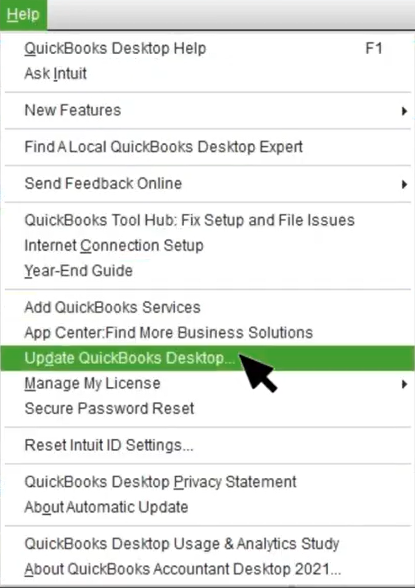
Step 3: Click on Update QuickBooks Desktop from the drop-down list that appears after clicking on Help.
Click on Update QuickBooks Desktop from the drop-down list that appears after clicking on Help.
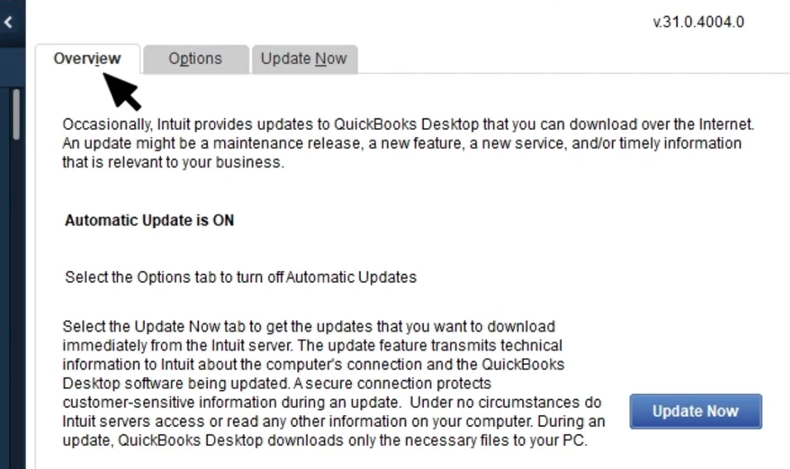
This action will redirect you to the Overview tab of the Update QuickBooks window, where you can manage update settings. (shown below)
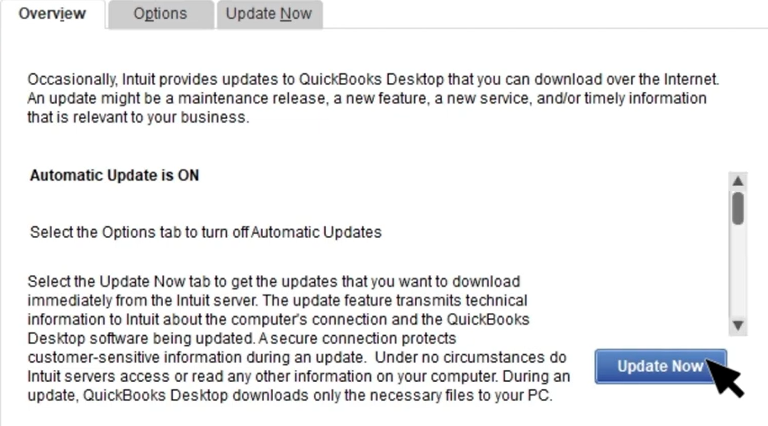
Step 4: Select Update Now.
In the update window, click on Update Now to prepare to download the latest updates.
OR

Step 5: When you are ready to update, select Get Updates.
When you are ready to proceed with the update, click on Get Updates. This initiates the download process for any available updates for your version of QuickBooks.
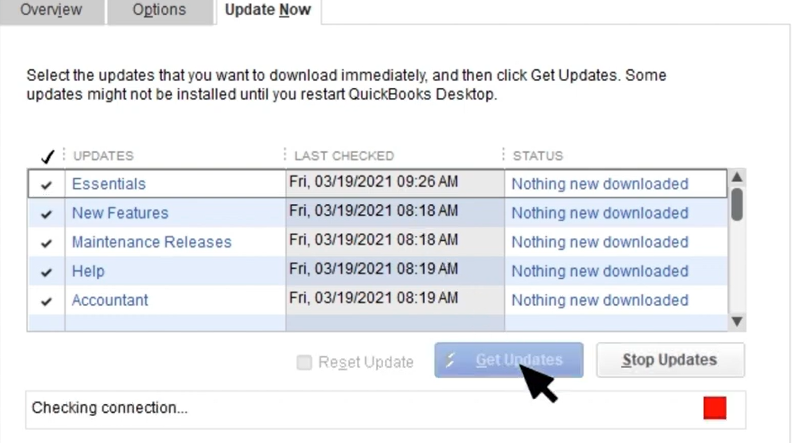
QuickBooks will now start downloading updates. Once the download is complete, the user will see the below prompt directing the user to restart QuickBooks in order to install the update.
QuickBooks will now start downloading updates.
Step 6: Click on OK to restart and install the update to complete the update process.
Once the download is complete, a prompt will appear directing you to restart QuickBooks to install the updates. Click OK to restart and allow the installation process to complete.
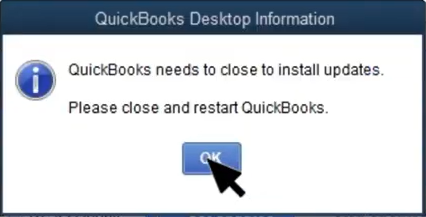
To configure QuickBooks to update automatically whenever an update is available, follow the below steps:
Step 1: Launch QuickBooks Desktop.
Open the QuickBooks Desktop application on your computer to begin the update process.
Step 2: Select Help.
In the top menu bar, click on the Help option. This will open a drop-down menu with various help-related options.
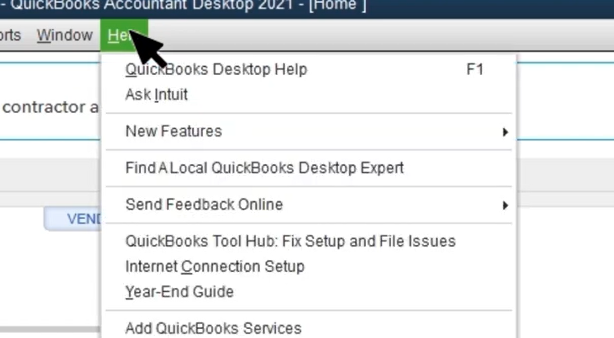
Step 3: Click on Update QuickBooks Desktop
From the dropdown list that appears after selecting Help, click on Update QuickBooks Desktop.
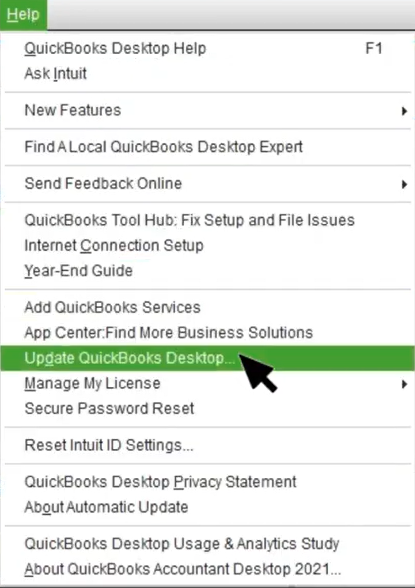
The user will then be redirected to the Overview tab, where you can manage update settings. (shown below)
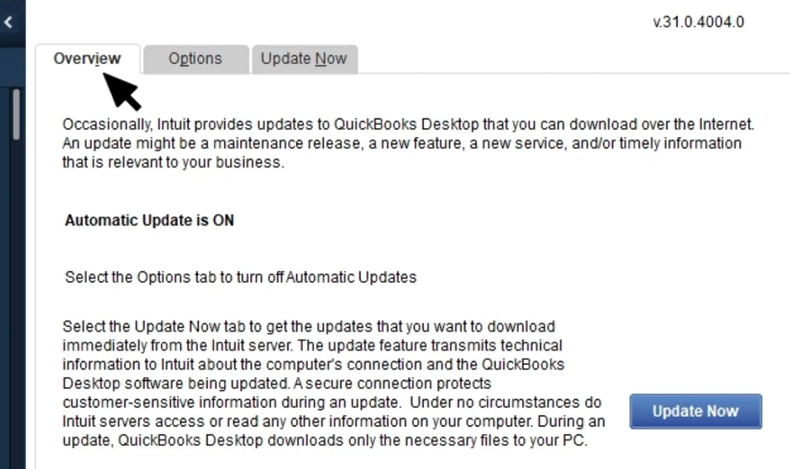
In the Overview tab, the user can see if the automatic updates are turned on or off.
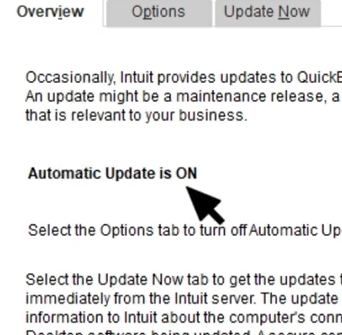
Step 4: To turn on Automatic Updates, select Options.
Look for an Options button in the Overview tab if the automatic updates are off. Click on it to access settings related to automatic updates.
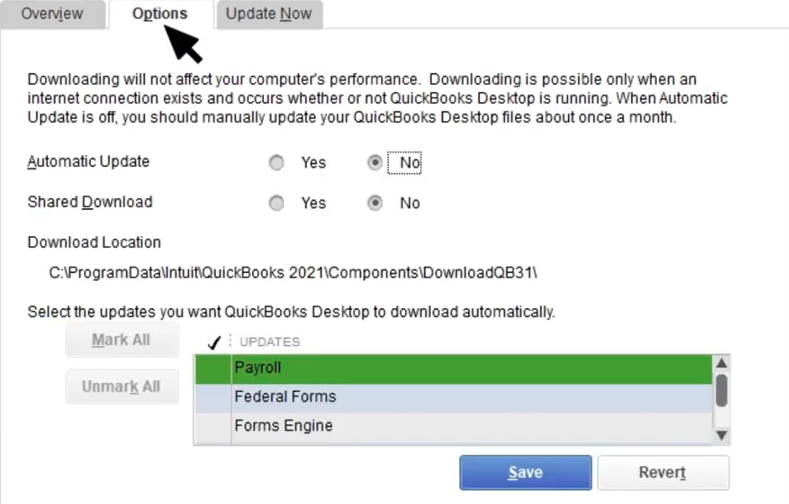
Step 5: Select “Yes” to turn on Automatic Updates.
When prompted, choose Yes to enable Automatic Updates. This setting ensures that QuickBooks will automatically download and install updates as they become available.
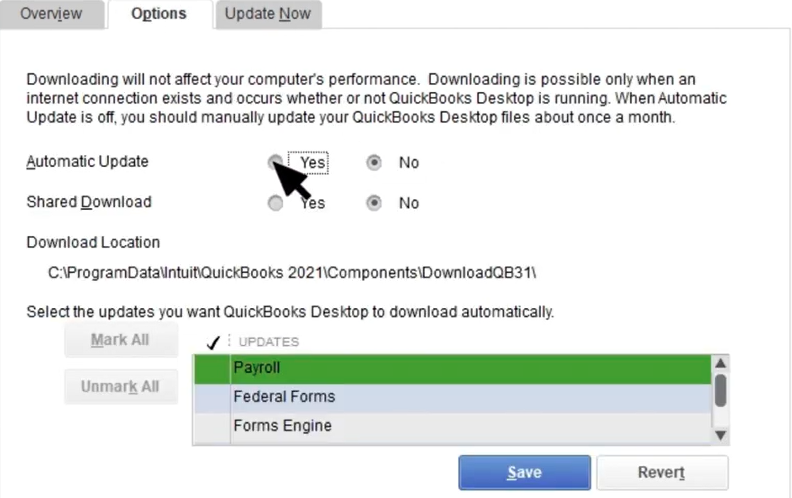
Step 6: Click on Save to save changes.
Finally, click on Save to confirm your changes. This will activate the automatic updates feature, which allows QuickBooks to keep itself up-to-date without further manual intervention.
Note: The following prompt will appear from now on every time QuickBooks has a new update
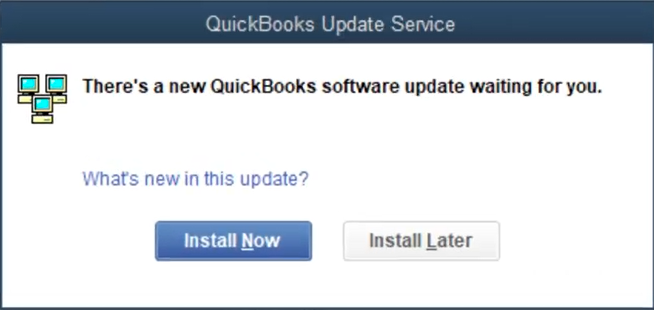
The users can update QuickBooks Desktop manually or set it to update automatically whenever a new update is available.
To manually update QuickBooks, follow the steps below:
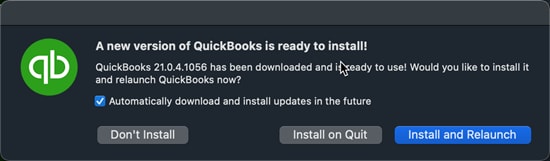
QuickBooks will now install the update and relaunch itself automatically once the update is done.
To set QuickBooks to update automatically whenever an update is available, follow the below steps:
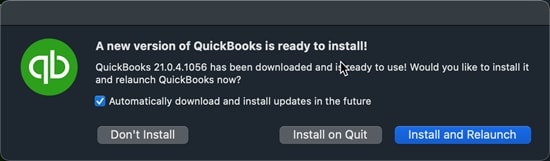
From now on, the QuickBooks updates will be automatically downloaded and installed.
In case the update won’t advance to the next release number, or the user may encounter an error during the update installation.
Follow the following steps to bypass this issue and install QB update:
Solution 1: Re-download the update.
Solution 2: End certain background processes.
Solution 1: Re-download the update.
Solution 2: Download updates from the official site.
Once the download finishes, open the file to install the update. Then, restart the operating system to finish the update process.
The above steps should help you overcome update issues in QuickBooks on both Windows and macOS. If you encounter an error during the update installation or the update doesn’t advance to the next release number, these solutions can help fix those issues.
| FAQ: Why is it important to update QuickBooks? |
QuickBooks offers a multitude of benefits to business owners, aiding in efficient financial management and informed decision-making for business growth and success.
QuickBooks update can offer several benefits with each update, including:
Intuit, the creator of QuickBooks, regularly introduces new versions of the software. These are categorized as “Updates,” which are free, and “Upgrades,” which require a purchase.
| FAQ: What is the difference between QuickBooks “Updates” and “Upgrades”? |
Intuit offers a variety of QuickBooks products. It’s important to note that they provide both desktop versions (Pro, Premier, Enterprise, etc.) and online versions (Online Essentials, Plus, etc.). The online versions are updated automatically in the background, so the “upgrade” vs. “update” discussion is only relevant to the desktop versions.
Updates are designed to enhance the functionality of the software the user has already purchased, ensuring its long-term usability. They’re always free and include fixes and performance improvements. On the other hand, upgrades are like new versions of the software, offering new features, tools, and significant enhancements. These are optional and available for purchase.
In summary, each QuickBooks update offers numerous benefits to business owners. It helps manage finances efficiently, ensures accuracy, provides real-time data, and scales with the business, all of which contribute to the growth and success of the business.
Updating QuickBooks isn’t just a task—it’s a process that affects performance, security, and accuracy. This section dives deeper into critical subtopics that users often overlook. From troubleshooting failed updates to understanding edition-specific behaviors, you’ll gain the clarity needed to manage every update with precision and confidence.
If your QuickBooks Desktop fails to update, follow these 3 critical actions: (1) Re-download the update manually using the Update Now tab—this resets broken connections. (2) End background processes like QBW32.exe and qbupdate.exe using Task Manager to clear memory conflicts. (3) Run QuickBooks as administrator—this ensures permissions are granted for the update. These steps fix over 80% of update errors. Repeat the process twice if the release version doesn’t change. Always restart your system after updating to finalize changes. Skipping these can cause version mismatches, blocked features, or data sync errors in real-time environments.
QuickBooks offers two update methods—each with 3 distinct impacts. (1) Manual updates give full control, letting users test stability before applying changes. (2) Automatic updates ensure you never miss critical patches, especially for security and compliance. (3) Hybrid approach (manual check + auto-install) helps users maintain oversight while staying current. Manual is best for IT-managed environments; automatic suits solo users needing zero downtime. Choosing the right method affects system performance, error prevention, and legal compliance. Always verify which update mode is active to avoid missing vital version upgrades or introducing bugs from outdated files.
To confirm your QuickBooks update worked, follow these 3 fast checks: (1) Press F2 or Ctrl + 1 to open the Product Information window—check the version and release number. (2) Compare this number with the official release notes on Intuit’s site to ensure it matches the latest. (3) Test core functions like reporting, invoicing, and backup to verify stability. A mismatch in version means the update failed or partially installed. Ignoring verification can lead to broken features, compliance risks, and corrupted company files. Always log update dates for record-keeping and audit purposes.
Each QuickBooks Desktop edition processes updates differently, impacting 3 key areas: (1) Update frequency—Enterprise gets more frequent patches for advanced features, while Pro and Premier receive general fixes. (2) Feature delivery—Enterprise updates may include exclusive tools like advanced reporting or inventory modules. (3) System requirements—Enterprise updates often demand higher RAM and CPU specs compared to Pro or Premier. Users must check compatibility before applying updates to avoid performance lags or crashes. Understanding your edition helps ensure smoother upgrades, proper resource allocation, and consistent functionality across devices and users.
Admin access affects 3 core parts of QuickBooks updates: (1) Permission control—only administrators can install updates, preventing unauthorized changes. (2) File locking—admin mode ensures no company file conflicts occur during installation. (3) Update stability—running QuickBooks as admin reduces errors from blocked processes or registry access. Without admin rights, updates may stall, misapply, or silently fail. Always right-click and choose “Run as Administrator” before starting the update. Skipping this step can result in partial installs, missing features, and repeated error messages. Admin access is non-negotiable for reliable updates and secure data handling.
Even the best update guide isn’t complete without addressing what surrounds it. This section covers high-impact but often ignored areas like system prep, multi-user coordination, and tool-based fixes. These insights help prevent silent failures, reduce update downtime, and ensure your QuickBooks stays stable across every user and device.
Many users hold 3 major misconceptions about QuickBooks updates: (1) “Updates are optional”—in reality, skipping them can break features, cause tax errors, or create compatibility issues. (2) “Updates and upgrades are the same”—updates are free improvements; upgrades are paid new versions. (3) “Auto-update means everything is handled”—not true; some updates still need user confirmation or admin access. Believing these myths can delay fixes, reduce performance, and even corrupt financial data. Always review update notes, check your edition’s needs, and never assume QuickBooks is fully updated without verifying the release version.
Before updating QuickBooks, follow these 3 prep steps to avoid errors: (1) Backup your company file—always create a local and cloud backup to prevent data loss. (2) Close background apps—end all non-essential programs, especially antivirus and syncing tools, to reduce update conflicts. (3) Check admin access and internet stability—ensure you’re logged in as admin with a strong, uninterrupted connection. These actions reduce the risk of partial installs, file corruption, and version mismatches. Skipping prep can turn a 5-minute update into hours of recovery. Always prepare before you click “Update.”
QuickBooks updates can disrupt 3 key functions in multi-user mode: (1) Version mismatch—if one user updates and others don’t, it blocks access and causes syncing issues. (2) File hosting errors—updates may reset hosting settings, requiring manual reconfiguration on the server. (3) User permissions—new patches can alter access rules, leading to denied actions or missing features. To avoid downtime, always update all workstations together and verify that multi-user mode is re-enabled post-update. Ignoring this causes file lock errors, lost changes, and slowed productivity in collaborative environments.
To avoid disruptions, apply these 3 best practices when scheduling QuickBooks updates: (1) Choose off-hours—schedule updates after business hours or during low-activity periods to prevent work interruptions. (2) Notify team members in advance—alert users to save work and close QuickBooks before updates begin. (3) Test updates on one system first—use a single workstation to verify stability before applying changes company-wide. These steps minimize downtime, prevent version conflicts, and safeguard financial data. Poor scheduling can cause halted workflows, update failures, or misaligned software versions across users.
QuickBooks Tool Hub solves 3 common update issues fast: (1) Runs Quick Fix My Program—this repairs basic installation errors that block updates. (2) Uses Install Diagnostic Tool—it scans and fixes .NET Framework, MSXML, and C++ issues critical for update success. (3) Resolves network and file permission errors that cause failed installs in multi-user setups. Download it from Intuit’s official site and install it on the affected machine. This tool reduces update troubleshooting time by over 70%. Skipping it can lead to repeated errors, wasted hours, and incomplete version installs.
The distinction between an update and an upgrade is crucial because one is free and mandatory, while the other is paid and optional.
Admin access is necessary because the update process involves making fundamental changes to the operating system’s files, registry, and services that are essential for QuickBooks to function.
When an update fails, it is often because critical QuickBooks processes are running in the background, locking files the update needs to overwrite. You should use the Windows Task Manager (under the Details tab) to end the following specific processes:
Updates significantly impact multi-user access because all workstations must be running the exact same release number to connect to the company file on the server.
Ending non-essential background applications, especially security software, is a crucial preparation step to prevent update failures due to file conflicts or interruptions.
The most efficient approach is to first re-download the update manually from within QuickBooks (using Help > Update QuickBooks Desktop > Get Updates). If that fails, then use the QuickBooks Tool Hub for a deeper fix.
The most critical mandatory benefit, often overlooked in favor of new features, is Regulatory and Tax Compliance.