Add As A Preferred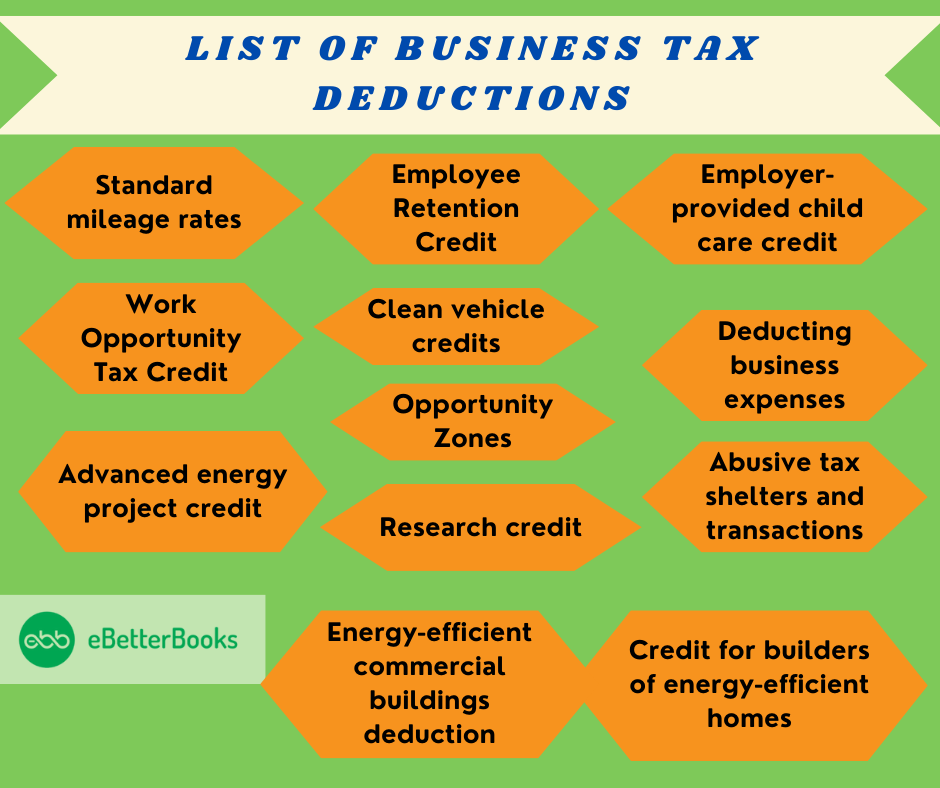
A corporate business tax deduction refers to the items or expenses that are eligible from the overall revenue in order to determine the total taxable income. These deductions are a form of tax relief that is given to businesses.
These deductions help the small businesses to lower the amount of total income that is subject to tax and this will ultimately reduce the tax liability. The corporation needs to file its tax return annually.
These returns will depict the company’s gross income and all the claimed deductions. After deducting the claimed deduction from gross income the taxable income is calculated which further will be multiplied by the appropriate tax rate. Finally, you will get the amount that the business exactly owes.
These deductions cover many common and essential costs paid during the operation of the firm. Rent, utilities, staff pay, company travel expenses, and the cost of items sold are typical examples. Depreciation on equipment, interest on business loans, and costs for expert services like accounting or legal fees are examples of additional deductions.
Small businesses can minimize their overall tax burden by lowering their taxable revenue through the use of allowable deductions. Maintaining accurate records is necessary to guarantee adherence to tax regulations.
A standard mileage tax deduction is the default cost per mile for taxpayers who deduct the expense of using their vehicle for charitable, business, or medical purposes. It is set by the Internal Revenue Service (IRS).
The tax rates differ annually, and they are the same for all types of vehicles, whether electric or gas-powered. The current Standard mileage rate is 67 cents per mile.
The Work Opportunity Tax Credit is a federal tax credit for businesses. It is a powerful incentive for employers, offering tax credits for hiring individuals from certain targeted groups who have faced barriers to employment.
Employers must first get certification from a State Workforce Agency (SWA) stating that the new hire satisfies the requirements of one of the target groups before they may submit a claim for a Work Opportunity Tax Credit. IRS Form 8850 and one of two Department of Labor forms are used for this.
Opportunity Zones are tax incentives to encourage investment and growth in distressed areas of the United States.
These economic development tools are used for commercial and industrial real estate, infrastructure, and housing.
Employee Retention Credit (ERC) is a refundable payroll tax credit designed to encourage employers to retain their employees during the COVID-19 pandemic tax years 2020 and 2021.
It is also known as the Employee Retention Tax. Companies who file an adjusted Form 941 X – Quarterly Federal Payroll Tax Return for the quarters in which they were an Eligible Employer are still able to apply for the ERC.
The clean vehicle credit is a nonrefundable credit meant to lower the cost of qualifying plug-in electric or another clean vehicle.
Clean vehicles include battery electric vehicles, plug-in hybrid vehicles, and fuel-cell electric vehicles. Always determine if your vehicle qualifies for the tax credit criteria or not.
Eligible contractors who build or reconstruct qualified energy-efficient homes can significantly boost their finances by claiming tax credits of up to $5,000 per home. This serves as a strong incentive for them to engage in energy-efficient construction.
The Advanced energy project credit is a lucrative opportunity for manufacturers and other entities. By investing in qualifying advanced energy projects, they can benefit from this credit, available through the Department of Energy, which is designed to encourage and support such investments.
The Employer-provided childcare credit is designed to help employers cover some childcare facilities for their employees. Companies that provide childcare for their employees become eligible for the tax credit.
Under the Employer-Provided Childcare Credit, employers can receive a tax credit of up to $150,000 annually to offset 25% of qualified childcare facility expenses and 10% of qualified child care resource and referral expenses.
For those interested in the Research credit, the IRS provides comprehensive guidelines and audit technique guides to assist in the examination of research credit cases, ensuring a clear and most importantly, a fair process.
It’s crucial to understand the different types of business expenses, and the general rules for deducting expenses. This knowledge will help you navigate the tax system effectively and ensure you’re not missing out on potential deductions.
Energy-efficient commercial buildings tax deduction is a federal incentive designed to promote energy efficiency in commercial buildings. It is also known as Section 179D.
Building owners stand to benefit significantly by increasing energy efficiency in certain building systems by at least 25%, as they may be able to claim a tax deduction. This not only reduces their tax burden but also contributes to a more sustainable environment.
The IRS has a comprehensive strategy to combat abusive tax shelters and transactions, which includes guidance on abusive transactions, regulations governing tax shelters, and a hotline for taxpayers to report abusive technical transactions.
Your business needs to promote itself for acquiring new customers so the IRS allows tax deductibility of associated costs.
Through depreciation, you can deduct the expense of business property into smaller installments instead of taking a full deduction in one fiscal period.
The Section 179 deduction enables small business owners to completely deduct qualifying business equipment expenditures when purchased during a year (until specific thresholds apply).
Essential professional services your business needs qualify for tax-deductible expenses.
You can deduct interest expenses for any business loans you receive because payments for these loans form a deductible expense.
To claim small business tax deductions, you need to fill out the Schedule C tax form and then report the profit on the personal Form 1040 and calculate the taxes due from there.
The Schedule C form is used to determine the taxable profit in your business during the tax year. You then report this profit on your personal 1040 form and calculate the taxes due from there. If you are looking to choose a Tax Service Provider, eBetterBooks could be a good choice.
Tax burdens can be greatly decreased for both individuals and corporations by fully utilizing the tax deductions.
EBetterBooks provides professional tax services that are specifically designed to guide you through the complexities of tax deductions.
Services like those provided by eBetterBooks can give crucial support if you’re looking for detailed advice on maximizing your deductions and ensuring compliance with tax rules.
These services are not just about managing your money better, but also about maximizing your tax savings.
The requirements ensure your deductions have a better chance of passing an audit examination. The IRS requires both proper documentation and a defined business need for each expense to ensure eligibility for your deductions.
Your business tax deductions depend on the expense being both “ordinary” and “necessary” for conducting your business operations alongside being used only for business functions, documented properly, and claimed correctly in the same income tax period. By maintaining excellent record-keeping practices along with tax law comprehension you can both optimize your deductions and ensure your financial compliance.
Conclusion
The value of tax deduction in a small business represents both an important tax liability reduction method and an essential practice for compliant business operations. Businesses that capitalize on pre-approved tax deductions including operating expenses alongside employee compensation, supplies, travel, and professional service can substantially decrease their taxable income and maintain greater financial control.
Taking advantage of tax deductions enables businesses to grow faster by reinvesting the saved amount. However, it’s crucial to ensure that your deductions are properly documented.
A business tax deduction is an expense that a business can subtract from its gross income to reduce its taxable income, ultimately lowering its tax liability.
There are numerous types of tax deductions, including but not limited to business operating expenses, employee compensation, supplies and equipment, travel, advertising, depreciation, professional services, and loan interest.
A deduction is an expense that reduces taxable income, and the types of deductions can include operating costs, employee wages, equipment purchases, travel expenses, and more, depending on the nature of the business.