Add As A Preferred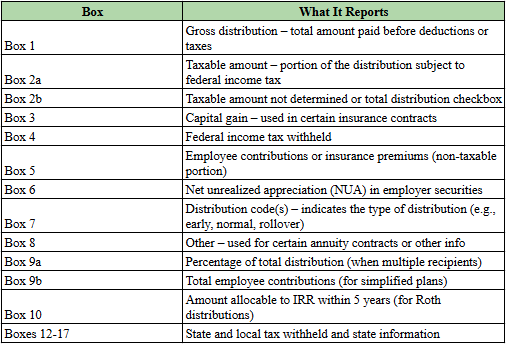
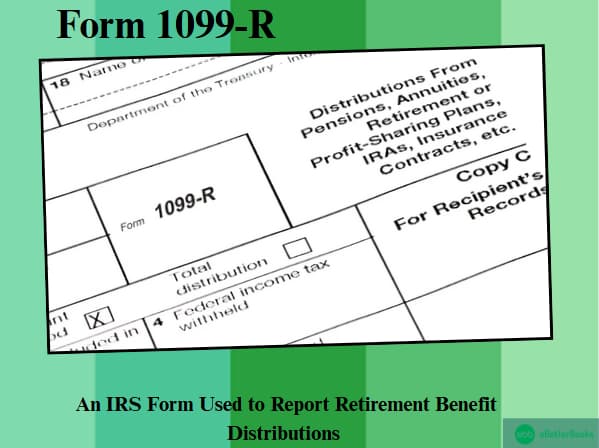
Form 1099-R is an IRS information return used to report the payment of $10 or more from pensions, annuities, retirement or profit-sharing plans, IRAs, insurance contracts, or other retirement accounts. The form is issued by a financial institution, insurance company, or plan administrator to both the taxpayer and the IRS to record the distribution and tax consequences.
The form has the total amount paid out, the taxable amount, federal and state withholding taxes, and a distribution code to determine the type of distribution. Although a non-taxable distribution, it still requires reporting it to your federal tax return.
The following institutions provide Form 1099-R:
Taxpayers who receive one of the following can receive a Form 1099-R:
Form 1099-R is required to be furnished on or before January 31 of the next year after the tax year in which the distribution was made. A copy is given to the IRS and a copy is mailed or made electronically available to the recipient.
Step 1: Gather all of your Form 1099-Rs
Collect all 1099-R forms you’ve received for the tax year. They’ll send you a separate form if you have more than one retirement distribution.
Step 2: Check Box 1 (Gross Distribution)
This is the entire sum distributed. It is not always all taxable.
Step 3: Check Box 2a (Taxable Amount)
This is the taxable part of the distribution. If Box 2b is marked (“Taxable amount not determined”), you might have to estimate the taxable amount yourself, particularly in the instance of rollovers or after-tax contributions.
Step 4: Report the Taxable Amount on your Form 1040
Report the Box 2a amount on Line 4b (IRA distributions) or Line 5b (pensions and annuities) of your Form 1040, depending on the source.
Step 5: Report Gross Amount if Necessary
If some or all of your distribution is tax-free, however, report the entire amount (Box 1) on Line 4a or 5a of Form 1040, and report the taxable portion on Line 4b or 5b.
Step 6: File Form 8606 if Necessary
Use Form 8606 to figure the taxable amount if:
Step 7: Report Federal Withholding in Box 4
Enter the amount in Box 4 on Form 1040, Line 25b as federal tax withheld. This lowers your tax bill or boosts your refund.
Step 8: Apply Early Withdrawal Penalty if Applicable
If you are under age 59½ and the distribution is not qualified, you might owe a 10% additional tax, unless there is an exception. Use Form 5329 to report exceptions or penalties.
Step 9: Check Box 7 Distribution Code
The code describes the reason for the distribution.
Examples:
1 = Early distribution (no known exception)
2 = Early distribution (exception applies)
3 = Disability
4 = Death
7 = Normal distribution
G = Direct rollover (not taxable) Codes influence how you report the distribution and if any penalties apply.
Step 10: Report State Tax (Boxes 12–14) if Applicable
If state tax was withheld, report it on your state income tax return.
Step 11: Keep all 1099-R Forms for your Records
Keep the forms even if no tax is owed, for audit purposes and to record retirement distributions.
Backup withholding could be withheld if you didn’t give the payer or the IRS a valid TIN. Backup withholding is 24% currently. If withheld, it will be shown on Form 1099-R in Box 4 and can be applied as a credit against your tax return.
Retain Form 1099-R and supporting documents for at least three years.
You might need the:
Form 1099-R is essential for reporting distributions from retirement plans and similar accounts. Whether taxable or not, each distribution must be reported accurately on your tax return using Form 1040. Understand the meaning of each box, use the correct IRS forms (such as 8606 or 5329) when necessary, and always reconcile the information with your own records. Receiving this form does not always mean you owe tax—but ignoring it can result in IRS notices and penalties.
It reports distributions from retirement accounts, including pensions, IRAs, and annuities.
Not always. Roth IRAs may be tax-free. Rollovers and return of after-tax contributions may also be non-taxable.
By January 31 of the year following the distribution.
It is still reported on Form 1099-R but usually with Code G (direct rollover), showing it is non-taxable.
Yes. Even if the distribution is non-taxable or has no withholding, it must be reported.