Add As A Preferred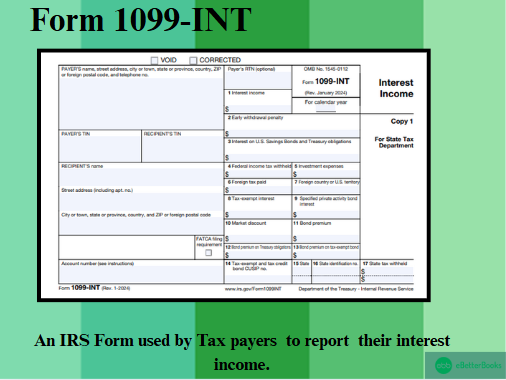
IRS Form 1099-INT depicts the breakdown of the total interest an individual earned in the previous taxable year. This form is generally issued by entities such as banks, investment firms, or other financial institutions.
These entities are also known as interest-paying entities as they pay interest to taxpayers and have detailed record of each account. Those who receive more than $10 as an interest income are required to file Form 1099-INT sent by financial entities under IRS guidelines.
The form must be filed by the following:
Entities that pay interest income to individuals must issue Form 1099-INT by the 31st of January each year, to all the individuals to whom they have given or have earned an interest of at least $10. One copy is sent to the taxpayer and another one is submitted to the IRS.
| Filing Type | Due Date |
|---|---|
| Recipient Copy | Friday – January 31, 2025 |
| IRS eFile | Monday – March 31, 2025 |
| IRS Paper Filing | Friday – February 28, 2025 |
| Box | What It Reports |
|---|---|
| Box 1 | Taxable interest income—report on Form 1040 Line 2b or Schedule B if required |
| Box 2 | Early withdrawal penalty—deduct on Schedule 1 (Form 1040), Line 18 |
| Box 3 | Interest on U.S. Savings Bonds and Treasury obligations—taxable federally, usually not taxable at state/local level |
| Box 4 | Federal income tax withheld—report on Form 1040, Line 25b |
| Box 8 | Tax-exempt interest—report on Form 1040, Line 2a |
| Box 9 | Private activity bond interest—may be subject to alternative minimum tax (AMT) |
| Box 10–13 | Market discount, bond premium on Treasury obligations or tax-exempt bonds (if applicable) |
Step-wise explanation of how to report Form 1099-INT is as follows:
Step 1: Collect all of your 1099-INT forms
Get all of your Form 1099-INTs. You’ll receive one from each bank, credit union, or other payer that paid you $10 or more in interest during the year.
Step 2: Check Box 1 on each form
Box 1 lists the amount of taxable interest you received from that account. This is the key figure you will report on your tax return.
Step 3: Sum all Box 1 amounts
If you had over one 1099-INT, sum up all the Box 1 amounts. This is your total taxable interest income for the year.
Step 4: Report total interest on Form 1040, Line 2b
Report the entire total of taxable interest (from Step 3) on Line 2b of Form 1040. This is where the IRS will look for all of your interest income.
Step 5: Determine whether you must complete Schedule B
Use Schedule B (Form 1040) only if:
If none of these, you can omit Schedule B.
Step 6: Complete Schedule B if necessary
If you are completing Schedule B:
Step 7: Report tax-exempt interest (Box 8)
Step 8: Report U.S. savings bond or Treasury interest (Box 3)
If you received interest in Box 3, it was from U.S. government bonds.
It’s still taxable on your federal return:
Step 9: Report early withdrawal penalties (Box 2)
Step 10: Report federal tax withheld (Box 4)
Step 11: Report premiums on bonds or market discounts (Boxes 10–13)
If you have figures in these boxes:
Step 12: Report just your portion if the interest is yours and someone else’s
If the 1099-INT contains interest that is another person’s (such as a joint account):
Step 13: Report interest even if you didn’t receive a 1099-INT
If you made interest but did not get a 1099-INT (for instance, if it was less than $10):
Step 14: Save your 1099-INT forms for your records
Save all original 1099-INT forms, even though you don’t have to mail them with your return. The IRS might want to see them later.
Step 15: Report interest on your state tax return if required
Each state has different rules:
If you earned more than $10 in interest from an institution but didn’t receive the form:
If the form arrives later and shows a discrepancy, you may need to file Form 1040-X (Amended U.S. Individual Income Tax Return).
Backup withholding occurs when a financial institution or a bank must withhold a flat rate of 24% of your interest income and remit to the IRS. This occurs when you failed to provide the correct taxpayer identification number (TIN) or where the payer was informed by the IRS that you are subject to it because there was underreporting or mismatch in the past.
If backup withholding was withheld, it will be shown in Box 4 of your Form 1099-INT. You are still required to report the aggregate interest from Box 1 on your tax return, but you can offset the amount in Box 4 as federal income tax paid. It can lower your tax payment or enhance your refund.
To prevent future backup withholding, furnish the accurate TIN and address any problem the IRS pointed out.
The record of Form 1099-INTs and related statements must be kept for at least 3 years.
These records may be required in future in case:
Form 1099-INT is a primary tax form that is used to report interest income from credit unions, banks, brokerages, and other financial institutions. Whether the interest is tax-exempt or taxable, it is required to be reported on your federal tax return. Knowing what is in each box on the form, where and how to report the numbers, and special rules such as early withdrawal penalties, backup withholding, and nominee distributions assist in accurate filing. Even though you may not get a 1099-INT, you still have to report all interest income.
It reports interest income of $10 or more earned from banks or financial institutions.
Contact the issuer for a corrected form. Report correct info on your return if needed.
By January 31 of the year after the interest was paid.
Form 1099-DIV reports dividends from stocks/funds, while 1099-INT reports interest income from bank accounts or bonds.
There is no specific exemption limit; all interest income must be reported, though it may not be taxable if total income is below the filing threshold.