The process of importing an accountant’s adjustments into a live QuickBooks file is essential for maintaining accurate financial records while ensuring daily business operations continue uninterrupted. QuickBooks uses the “Accountant’s Copy” feature, which creates a file containing a dividing date, allowing the client and the accountant to work on the books simultaneously. This workflow maximizes efficiency, resulting in timely and precise financial reporting.
The changes, usually provided in a .QBY file, can be incorporated into the main company file via two methods: directly from the Intuit web server or by importing the file locally. Successfully applying these modifications requires attention to detail, specifically ensuring both the client and the accountant are using compatible QuickBooks versions to prevent common issues such as version mismatch errors or partial imports. Implementing these steps confirms the accountant’s necessary edits, like year-end journal entries, are correctly applied to the company data.
Highlights (Key Facts and Solutions)
- Core Feature: The content focuses on the Import Accountant’s Changes option in QuickBooks, which uses the Accountant’s Copy file format to merge professional adjustments with the client’s ongoing transactions without interruption.
- Data Exchange: The Accountant’s Copy is saved on the Intuit server, facilitating secure data exchange, and the client receives a file with the .QBY extension containing the revisions.
- Import Methods: Changes can be imported using one of two methods: Import Accountant Changes from the Web or Import Accountant’s Changes via File, with the latter often preferred for stability.
- Critical Compatibility: A key requirement for successful import is ensuring both the client and the accountant use the exact same version and release year of QuickBooks Desktop; version mismatch is a primary cause of import failure.
- Troubleshooting Solutions: Common issues and immediate fixes include:
- Locked File: Solution is to ensure all other users are logged out of the company file before starting the import process.
- Incompatibility: Solution is to confirm matching QuickBooks versions.
- Incorrect File Format: Solution is to ensure the file is the correct .QBY extension.
- Partial Import: Solution is to retry the import or request a fresh file due to potential corruption or connection issues.
Understanding Accountant’s Copy in QuickBooks
An accountant’s copy in QuickBooks is a file created by an accountant and then sent to the client after making any adjustments or edits for accounting purposes.
Now, the client imports this copy into a QuickBooks file and continues their regular business operations. The accountant’s copy is saved on the Intuit server, where a user can exchange data securely with accountants.
An accountant’s copy allows clients and accountants to work on the same set of books simultaneously. The importing process ensures accurate and timely financial reporting without losing any day-to-day transactions a user has entered in the meantime.
| Note: Accountants cannot update client company files into QuickBooks Desktop 2024. You have two options. First, use the older version of QuickBooks Desktop Accountant, and second, ask your client to update their file to QuickBooks Desktop 2024 and then send a new accountant’s copy. |
Key Takeaways:
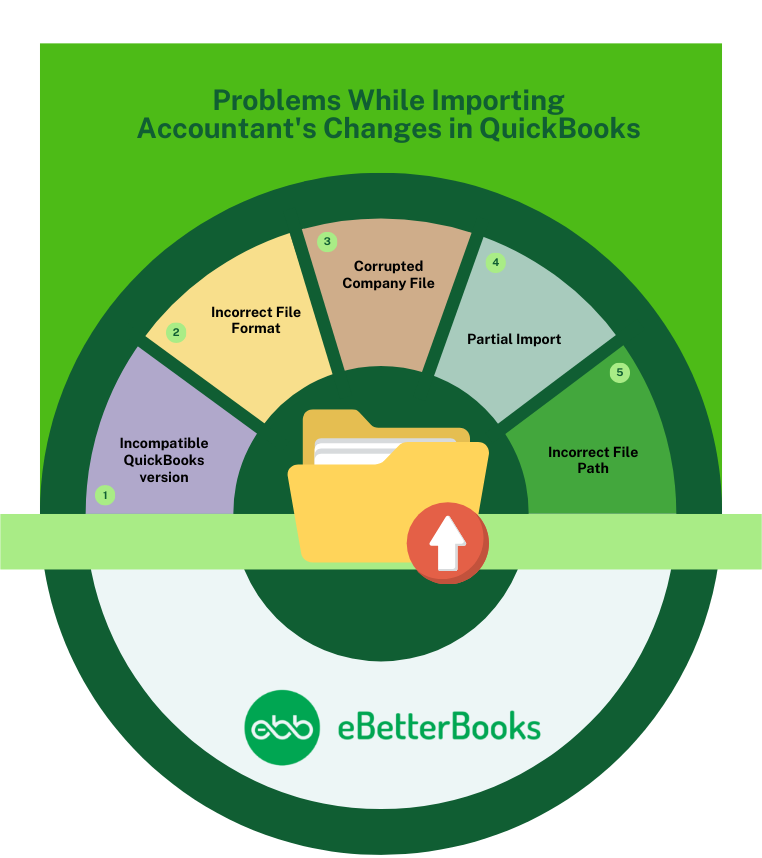
Problems: Incompatibility between QuickBooks version.
Solution: Make sure both the client and accountant are using the same version of QuickBooks software.
Problems: Incorrect File Format
Solution: Get the correct accountant’s changes file with .QBY extension.
Problems: Corrupted Company File
Solution: Get a new file from your accountant and download it completely.
Problems: Partial Import
Solution: Try to re-import the file.
Problems: Incorrect File Path
Solution: Make sure the file is correctly located.
How to Import Accountant’s Changes in QuickBooks
Importing changes in the accountant’s copy comes in need when a business owner is required to provide their accountant with the necessary data to review and make adjustments without interrupting the daily work.
When the account is done with the adjustments that were requested, these changes can be imported back into the main QuickBooks file. Now, importing accountant changes in QuickBooks can be done in two ways: either by importing through the web or by importing through a company file.
Import Accountant Changes in QuickBooks From the Web
- Launch QuickBooks Online and login using your credentials.
- Go to the File menu and select Open or Restore Company.
- Click Open a Company File, then Next.
- Click Browse and then choose the business file you wish to open.
- Select Open, then enter your login information.
- Navigate to the File menu, then choose Accountant’s Copy.
- Choose Import Accountant Changes from the Web.
- Download the accountant’s copy and make modifications.
For Business or Premier Edition Users:
- Launch QuickBooks Online and login using your credentials.
- Follow steps 2–5 above.
- Navigate to Client Activities and choose Import Accountant Changes from the Web.
- Download the accountant’s copy to apply the modifications.
Import Accountant’s Changes into QuickBooks via File
- Launch QuickBooks and log in using your credentials.
- Go to the File menu and select Open or Restore Company.
- Click Open a Company File, then Next.
- Click Browse and then choose the business file you wish to open.
- Select Open, then enter your login information.
- Navigate to the File menu, then choose Accountant’s Copy.
- For Enterprise Users: File > Client Activities → Import Accountant Changes from File.
- Select a file with the .qby extension and click Open.
- Review the revisions done by the accountant.
- Use the “+” symbol next to each modification to get more comprehensive dispute resolution recommendations.
- Choose Print or Save as PDF to keep track of the changes.
- Click Incorporate Accountant’s Changes to apply the changes to your company’s filing.
- Confirm the adjustments and click OK to close QuickBooks.
- Create a backup file at your selected place.
Check the included changes for correctness, then click Close.
Problems While Importing Accountant’s Changes in QuickBooks

Consider the following issues which may arise during the process and affect the working:
- QuickBooks version does not match with the file shared by an accountant.
- The company file (.QBY) can be corrupted, which can hinder the import process.
- An unstable internet connection can disrupt the importing process in QuickBooks Online.
- The company file (.QBY) can be locked, which means changes cannot be imported.
- Only some of the changes are imported due to partial import.
Conclusion
An accountant’s copy allows a client and accountant to have clear communication and understanding to ensure that changes are properly imported and reflected in the system. Importing accountant’s changes in QuickBooks can be hampered if the internet connection is not stable, the company file is corrupted, or due to partial import.
After considering the problems, a user can import accountant’s changes in QuickBooks in two ways, either through company file or through the web.
FAQs
What is an Accountant’s Copy, and how does it protect my daily business entries?
An Accountant’s Copy is a specific file format (designated by the .QBX extension when sent by the client, and .QBY when returned by the accountant) that allows your accountant to work on your books without interrupting your daily operations. When you create the copy, QuickBooks establishes a “dividing date.” Any transactions you enter after that date are protected and remain in your main company file, and they are automatically merged with the accountant’s changes upon import. This ensures minimal downtime and data integrity.
Why am I getting an error stating the QuickBooks version does not match, and how do I fix it?
This is one of the most common errors. The .QBY file can only be imported into the exact same version and release year of QuickBooks Desktop that was used to create the original Accountant’s Copy. For example, a file created in QuickBooks Desktop Pro 2023 cannot accept changes from an accountant working in a 2024 version.
To fix it:
1. Confirm: Contact your accountant to verify the exact year (e.g., 2023) and flavor (e.g., Premier, Pro) they used.
2. Update: Ensure both you and your accountant have the latest release updates installed for your specific version. You can check for updates under the Help menu in QuickBooks.My imported changes are only partial. What causes partial imports, and what should I do?
A partial import usually occurs when the connection is interrupted during the import process, or the .QBY file itself is incomplete or corrupted. This is more common when importing changes over a less stable internet connection (the Web method).
Action steps:
1. Check the File: If importing via file, ask your accountant to send a new .QBY file and ensure the download completes fully.
2. Verify Status: Before re-importing, check the Client Activities section in QuickBooks to see if the system registered the previous attempt.
3. Try Re-importing: Attempt the import again. If the issue persists, the accountant may need to undo the changes on their end and create a fresh Accountant’s Copy export.Can I continue to enter transactions while the accountant is working on the copy?
Yes, absolutely. This is the primary benefit of the Accountant’s Copy feature. After you create the dividing date, you can continue to enter your day-to-day transactions. When you import the .QBY file, QuickBooks handles the automatic merging of your new entries with the accountant’s adjustments (like journal entries or reclassification). The only restriction is that you cannot delete or edit transactions that occurred before the dividing date until the changes are imported.
What is the difference between importing changes “From the Web” versus “Via File,” and which is better?
Method: From the Web
Use Case: Used when your accountant uploads the .QBY file directly to the Intuit server.
Stability: Relies heavily on a stable internet connection during the download/import phase.Method: Via File
Use Case: Used when your accountant emails you the .QBY file or shares it via a cloud service.
Stability: More stable, as the download is already complete before you start the import inside QuickBooks.Importing Via File is often preferred as it isolates the import process from external download stability issues.
Why would my company file be locked, preventing the import of the changes?
The most common reason for a locked company file is that another user is logged in to the QuickBooks company file in multi-user mode. QuickBooks requires exclusive access to the file to perform the structural changes necessary during the import process.
To resolve the lock:
1. Ensure all other users are logged out of the QuickBooks file.
2. The person performing the import must be logged in as the Administrator or a user with full permissions.
3. If using a server, ensure no background processes are running or holding the file lock.Is the Accountant’s Copy feature compatible with QuickBooks Desktop 2024?
Yes, the Accountant’s Copy feature is compatible with QuickBooks Desktop 2024, but with a critical caveat. An accountant using a previous version of QuickBooks Desktop Accountant (e.g., 2023) cannot import or update a client file created in QuickBooks Desktop 2024.
The solution is two-fold:
1. The client must update their file to QuickBooks Desktop 2024 and send a new Accountant’s Copy to the accountant.
2. The accountant must update their QuickBooks Desktop Accountant software to the 2024 version to work with the client’s file.
Disclaimer: The information outlined above for “How to Import Accountant’s Changes in QuickBooks? – DIY Solutions” is applicable to all supported versions, including QuickBooks Desktop Pro, Premier, Accountant, and Enterprise. It is designed to work with operating systems such as Windows 7, 10, and 11, as well as macOS.