Add As A Preferred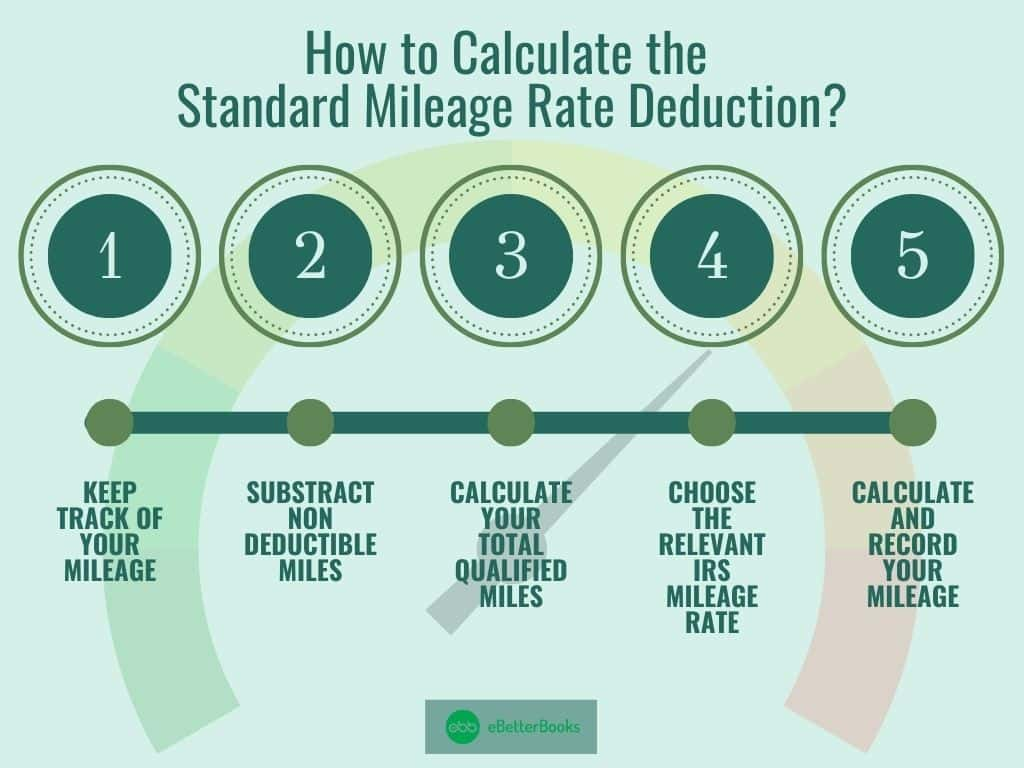
The IRS standard mileage rate is an annual rate applied to calculate deductible vehicle expenses without accounting for actual costs. It’s derived from an annual survey of fixed and variable expenses, such as fuel, maintenance, depreciation, and insurance.
The standard mileage rate is revised yearly by the Internal Revenue Service (IRS) and applies to deducting miles driven for business, medical, moving, or charitable activities. Self-employed professionals and businesses mostly utilize this method for mileage reimbursement.
If your mileage deduction is substantial, consider hiring a tax professional to help you comply with all IRS regulations and receive the maximum benefits.
For the tax year 2025 (filed in 2026), the IRS mileage rates are:
| Standard Mileage Rate Categories | Rates |
|---|---|
| Business (an increase of 3 cents from 2024) | $ 0.70 |
| Medical or Moving (no change) | $ 0.21 |
| Charitable (no change) | $ 0.14 |
These rates are for gas, diesel, hybrid, and electric vehicles. Depending on the reason for travel, you need to record qualified miles separately.
The standard mileage rate method is used by:
To figure your tax deduction under the standard mileage rate, do the following:
Step-by-step process:
Example:
You traveled 30,000 miles for business in 2025.
30,000 x 0.70 = $ 21,000 business deduction
You can do the same calculation for other categories using the appropriate rate for each.
The IRS demands precise and detailed records to qualify for a mileage deduction. Partial or estimated logs may result in denied deductions or an audit.
What you Must Track/Record:
Tools you can utilize:
Log your miles daily or weekly to avoid forgetting details. It would be helpful to keep backup documentation such as appointment confirmations, receipts, or calendar events.
Reporting it properly on your tax return, include different IRS forms for different individuals:
For Self-Employed Individuals:
For Employees:
For Medical or Moving Expenses:
For Charitable Purposes:
Tip: Always use a tax professional or reputable tax software to make your deductions properly.
The IRS has provided two options for deducting vehicle expenses: the Standard Mileage Rate Method and the Actual Expense Method. Both have specific requirements, advantages, and limitations.
| Standard Mileage Rate Method | Actual Expense Method |
|---|---|
| Goes easy on the deduction with a standard per-mile rate. It pays for all car expenses, such as fuel, oil, repairs, upkeep, insurance, registration costs, and depreciation. | It requires a detailed record of every actual cost related to operating the vehicle, such as gasoline, repairs, insurance, tires, lease or rental payments, and depreciation. |
| It requires the calculation of miles operated for each entitled use but not actual costs. | You have to determine what percentage of overall vehicle usage was for qualified purposes in order to use that share of total costs. |
| Must be utilized in the initial year in which the vehicle is put to use if you wish to opt for actual cost later. | More accurate, but it needs heavy paperwork. |
Once you select the actual expense method, you cannot revert to the standard mileage rate for the same vehicle.
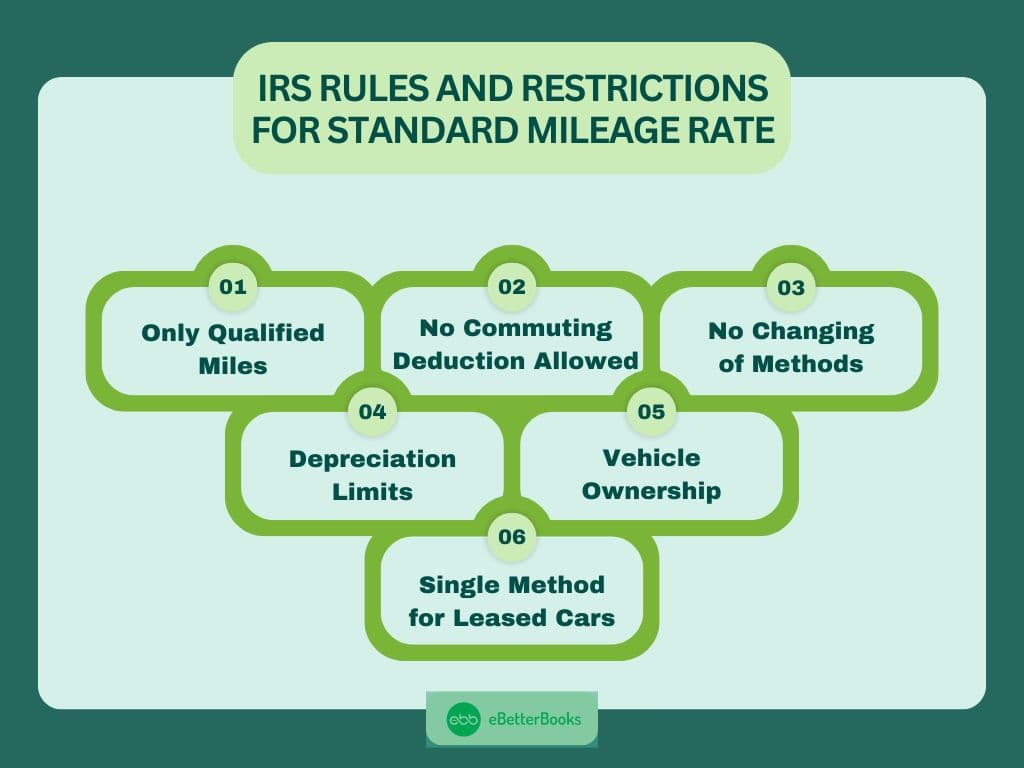
The IRS has certain rules and restrictions to make sure that mileage deductions are proper and not misleading:
It is important to know the distinction between being reimbursed and taking a deduction:
| Mileage Reimbursement | Mileage Deduction |
|---|---|
| When your employer reimburses you for mileage (at or below the IRS rate), the reimbursement is not taxable, and you may not also deduct it on your return. | Applies only when you pay the mileage cost yourself and are not reimbursed. |
| If you’re reimbursed in excess of the IRS rate, the amount in excess is regarded as taxable income. | Typical for self-employed persons, freelancers, and gig workers. |
| Employers may use the IRS standard mileage rate as a baseline to reimburse employees reasonably for business use of personal cars. | This reduces your taxable income but not your tax bill directly. |
Key Takeaway: You can either be reimbursed or take a deduction—not both for the same mileage.
To get the most from your mileage deductions:
If your mileage deduction is substantial, consider hiring a tax professional to help you comply with all IRS regulations and receive the maximum benefits.
Using the IRS standard mileage rate to claim mileage deductions is an easy and effective method of reducing your taxable income, particularly if you drive regularly for business, medical, moving, or charitable reasons.
To take full advantage, keep accurate records, know what miles qualify, and use the option that best suits your financial position. Whether you’re a gig economy worker or a self-employed professional, being compliant with IRS guidelines can make a big dent in your taxes.
No, miles commuting home to your primary workplace and returning are not deductible, even when you’re self-employed. Just travel between business locations or to and from customer sites is.
Yes, but with restrictions. You must choose the standard mileage rate in the first year the car is used for business. In later years, you can switch to actual expenses but not the other way around if you’ve claimed depreciation under the actual method.
If you use the normal mileage rate, you have to use it consistently throughout the lease term (including renewal). It is easier, but the actual cost method could return a greater deduction if your lease payments and operation expenses are high.
There is no exact limit, but very high mileage (e.g., 50,000+ business miles) can lead to an IRS audit. Provided you keep accurate and detailed records, you can justify your claim irrespective of mileage.
For 2025, the IRS mileage rates are:
No. If you’re using the standard mileage rate, gas and other operation costs are factored in. If you’re using the actual expense method, you can deduct gas, maintenance, insurance, and depreciation, but not mileage.