Excerpt:
The QuickBooks Cash Flow Planner is a vital liquidity management tool that projects a business's future cash position by analyzing linked bank data, open invoices, and upcoming bills. The planner is specifically designed for short-term visibility, offering a reliable forecast up to 90 days into the future. Crucially, the planner's projections are kept separate from the official accounting records, meaning manually added items for scenario testing do not impact the General Ledger. The tool's accuracy relies heavily on users maintaining high data quality and correctly categorizing transactions, while also allowing for proactive financial management by setting a cash shortage threshold to trigger alerts before account balances drop too low.
 Add As A Preferred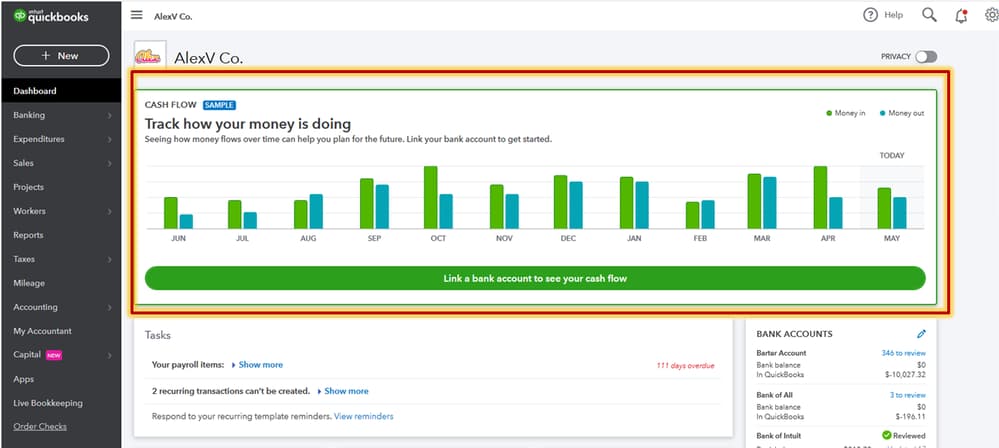
Highlights (Key Facts & Solutions)
Overview
QuickBooks provides Cash Flow Planner as an inbuilt tool for cash flow forecasting. The Cash Flow Forecasting Tool in QuickBooks is a decisive element designed to assist businesses handle their finances by forecasting prospective cash flow based on income and expenses.
This tool delivers a precise sight of expected cash inflows and outflows, permitting business owners to design effectively for upcoming periods, make knowledgeable decisions, and evade the issue of potential cash shortages.
By using this tool, users can track upcoming bills, sales, and additional financial activities, assuring they preserve adequate cash reserves to protect expenses. Whether you’re a small enterprise owner or a financial manager, utilizing QuickBooks Cash Flow Forecasting Tool can significantly improve your capability to supervise liquidity and financial health.
| Pros of QuickBooks Cash Flow Planner | Cons of QuickBooks Cash Flow Planner |
| Accessible on mobile and desktop platforms.Easy cash flow tracking for small businesses. Integrates seamlessly with QuickBooks accounting software.User-friendly interface and visual forecasts. Real-time updates for accurate cash flow insights.Syncs with bank accounts for live tracking. | Predictive accuracy depends on entered data quality. May lack advanced reporting for in-depth analysis. Not ideal for large enterprises or unique industries. Limited customization for complex cash flow needs. Requires QuickBooks subscription to access features. Additional costs for certain integrations and tools. |
In order to begin with the setup of the cash flow planner in QuickBooks, you first need to connect your bank and your credit card accounts. By doing so, you can easily use the data from your cart off accounts ( COA).
Steps to connect your bank and your credit card accounts:
Step 1: Click on the Transactions, then choose Bank Transactions.
Step 2: Choose Link Account.
Step 3: Put the URL or name of your bank in the Search field, then choose the bank.
Note: If you can’t find your bank, you can manually upload transactions instead.
Step 4: Enter your Sign info in the Login and Password fields, then select Continue.
Step 5: Choose the account that you want to connect and date to pull transactions from the dropdown .
Step 6: Then, select Next.
Note: Some banks let you download the last 90 days of transactions, while others can go back as far as 24 months.
Step 7: Choose your account type on the Account type drop-down, then select Next.
Note: Select the account type that matches your QuickBooks account chart. If you don’t see the correct account type, select +Add new.
If there is a new bank account:
Step 1: In the Account Type drop-down, choose Bank.
Step 2: In Detail Type, choose Savings or Checking.
Step 3: Assign the account a name and then choose Save and Close.
If there is a new credit card accounts:
Step 1: In the Account Type drop-down, choose Credit Card.
Step 2: Give the account a name and then choose Save and Close.
Step 8: Map the bank account in the Existing accounts dropdown, then select Next.
Step 9: Click on Connect, then select Done.
Note: You can edit the account name in the New account name field or change it later.
In this step, the user can add, edit, or delete an item in the income and expense planner.
Note: The items in the Planner aren’t actual transactions. So they won’t appear in your books.
Step 1: Click on the Dashboards and choose the planner option.
Note: If it’s your first time, select Start planning, then select Let’s go.
Step 2: Click on “Add item”.
Step 3: Choose the “Money in” option on the screen ( if the item is an income) or choose the “Money out” option ( if the item is an expense ).
Step 4: Put the name under the “Description field” and then mention the amount under the ” Amount field”.
Note: If it’s a recurring item, select Repeating. Then select how often the item repeats.
Step 5: Select Save.
Note: To export your cash flow details, select the Download Report dropdown. You can export the report as a CSV, PDF, or XLS file.
Step 1: Go to Dashboards and select Planner
Step 2: Select the item you want to edit.
Step 3: Edit the info.
Step 4: Select Update.
Step 1: Go to Dashboards and select Planner.
Step 2: Select the item you want to delete.
Step 3: Choose Remove, then choose Confirm.
Note: To delete an entire series, choose an item in the series, turn off the Repeating switch, choose Remove, and then select Remove again.
Choose the data you would like to view in your planner.
Here’s how to do it:
Step 1: Click on the Dashboards, then choose Planner.
Step 2: On the planner page, choose the gear icon.
Step 3: Select your preference.
Step 4: In the Linked Accounts section, select the accounts that you want to show in the Cash flow planner.
Note: Select Link bank account to link to another bank account.
Step 5: In the Threshold section, set an amount you don’t want to go under.
Step 6: Click on Save.
In conclusion, the Cash Flow Forecasting Tool in QuickBooks is essential for businesses looking to manage their financial health. It offers real-time insights into cash inflows and outflows, enabling informed decision-making. The tool integrates effortlessly with QuickBooks, pulling data from bank accounts and transactions. Whether planning for growth or managing expenses, it helps keep your business financially on track.
The QuickBooks Cash Flow Planner forecasts your business’s future cash position by combining two primary data sources to provide actionable insights.
The accuracy of the cash flow forecast is directly proportional to the quality and consistency of the data in QuickBooks. Users must focus on data integrity to ensure reliable predictions.
The Cash Flow Planner is fundamentally a planning tool separate from the official accounting records (the General Ledger).
While powerful for small to medium-sized businesses, the Cash Flow Planner has limitations related to depth and complexity, making it less suitable for large enterprises.
A connected bank account may stop providing real-time data due to several common issues that require troubleshooting both within QuickBooks and on the bank’s own platform.
The Cash Flow Planner allows users to set a minimum threshold, which acts as a visual and alert mechanism for anticipating financial shortages.
While the planner uses most bank-connected data, it specifically excludes certain transaction types that do not represent true cash movement or are tied to advanced accounting features.