Add As A Preferred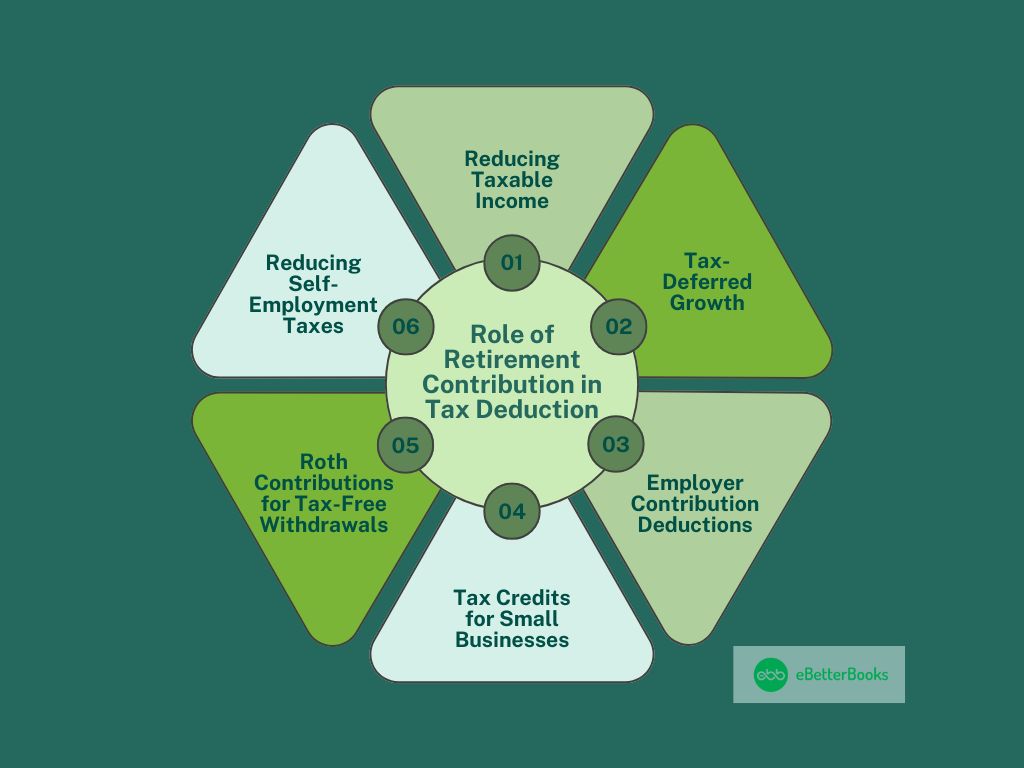
Retirement planning is an important part of financial security, not only for business owners but also for their employees. The best method to save for the future while dealing with tax obligations is through retirement contributions. Retirement contributions enable people to save money in tax-deferred accounts, which helps ensure financial security during retirement while gaining substantial tax benefits.
For entrepreneurs, providing a retirement plan not only allows them to save for themselves but also increases employee satisfaction, lowers turnover, and offers significant tax deductions. This article discusses the idea of retirement contributions, the advantages of providing a retirement plan, and how these contributions are an important tax deduction resource.
Employees, together with their employers, save funds into qualified retirement plans that are considered retirement contributions. People save retirement funds that multiply through time with investment income while securing their financial stability during retirement years. The central goal of retirement fund contributions exists to ensure senior citizens maintain their existing standard of living in retirement.
Business owners need to select from various retirement plans according to the size of their business structure and individual retirement goals, as well as employee requirements. Business owners have access to four retirement plan types, which include 401(k) plans, Simplified Employee Pension (SEP) IRAs, Savings Incentive Match Plan for Employees (SIMPLE) IRAs, and defined benefit plans. The decision to retire depends on its contribution limits, tax benefits, and administrative needs.
Two primary forms of retirement contributions exist:
There are two main tax-treatment categories for retirement contribution funds:
Providing retirement plans presents two-fold benefits to business entrepreneurs since it helps them save for their future while simultaneously strengthening their business tactics. An appropriately designed retirement plan delivers aligned advantages, including tax benefits and worker retention, which lead to business expansion.
A retirement plan allows employers to obtain substantial tax benefits, which represent a major business incentive for establishing such a program. The contributions employers make toward employee retirement funds become tax-deductible for companies. Contributions into qualified retirement accounts can accumulate tax-deferred until withdrawals, which will result in compound growth of earnings.
High-performing employees remain loyal, and new talented candidates seek employment because of business retirement plans and competitive benefit packages. Workers seek financial protection, so businesses offering retirement plans tend to maintain dedicated staff. Businesses that provide retirement plans demonstrate employee welfare concern, resulting in pleased workers who stay with the company.
Business owners routinely reinvest profits into their business operations rather than establish investments for their financial security beyond the business. A disciplined retirement plan provides business owners with savings mechanisms that help them reach their retirement goals while obtaining tax advantages. Small business owners can maximize their retirement funds using SEP IRAs and Solo 401(k)s because these plans extend their savings potential.
Internal retirement benefits make small businesses more attractive on the job market when compared to organizations without these benefits. Most candidates view organizations with beneficial retirement options when they consider potential employment opportunities. Such employee retirement benefit schemes enable organizations to be favored choices for potential candidates in the workforce.
Several retirement arrangements such as SIMPLE IRAs and 401(k)s enable staff members to deduct their contributions from their taxable income before taxes. The reduction in payrolled taxes affects both employee and employer. Employers get tax credits from the government, which they can use to pay for expenses when establishing new retirement plans.
Business owners need to make retirement contributions because they function as a strategy to decrease their tax expenses. Business owners benefit from retirement plan contributions because the funds let them decrease their taxable income and create safeguarded financial security for both themselves and their worker pool.
An owner of a business has the option to fund various retirement plans that carry distinct distribution structures and related tax benefits.
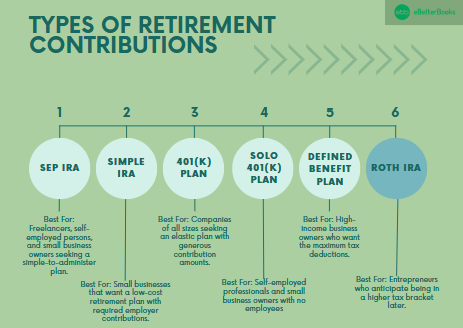
Small businesses, together with self-employed individuals, can use SEP IRA as their retirement plan. Employers using this plan receive permission to make deductible retirement payments toward their staff members and their accounts.
| Contribution Structure | Tax Benefits | Best For |
|---|---|---|
| The setup of new retirement plans by businesses with 100 employees or less entitles them to yearly tax credits reaching up to $5,000 during their initial three years. | Contributions are deductible, and the investments grow on a tax-deferred basis. | Freelancers, self-employed persons, and small business owners seeking a simple-to-administer plan. |
SIMPLE IRA is meant for small businesses with up to 100 employees. Both employer and employee contributions are allowed, which makes it a viable choice for businesses looking to offer retirement benefits.
| Contribution Structure | Tax Benefits | Best For |
|---|---|---|
| The employee contributes via salary deferrals, and the employer is required to match employee contributions or make non-elective contributions. | Employer contributions are tax-deductible, and employee contributions are pre-tax, lowering taxable income. | Small businesses that want a low-cost retirement plan with required employer contributions. |
A 401(k) is a common retirement plan in which employees can contribute a portion of their pay on a pre-tax or after-tax (Roth) basis. Employers can also elect to match employee contributions.
| Contribution Structure | Tax Benefits | Best For |
|---|---|---|
| Participants contribute from payroll deductions, and employers can provide matching contributions. | Contributions made under a Traditional 401(k) decrease taxable income, and Roth 401(k) contributions grow tax-deferred. | Companies of all sizes seeking an elastic plan with generous contribution amounts. |
A Solo 401(k) is used for self-employed workers or small business owners without any employees (with the exception of a spouse). It supports more contribution opportunities than other plans.
| Contribution Structure | Tax Benefits | Best For |
|---|---|---|
| Business owners may contribute as employees (salary deferral) and employers (profit-sharing). | Contributions are deductible, and investment returns accumulate tax-deferred. Roth Solo 401(k) features enable tax-free retirement withdrawals. | Self-employed professionals and small business owners with no employees. |
A Defined Benefit Plan is a retirement plan that offers a fixed amount at retirement. Employers make contributions according to a formula that takes into account salary and length of service.
| Contribution Structure | Tax Benefits | Best For |
|---|---|---|
| Contributions are actuarially determined to pay for future retirement benefits. | Contributions by employers are tax-deductible, and investment earnings are tax-deferred. | High-income business owners who want the maximum tax deductions. |
A Roth IRA is a type of individual retirement account in which contributions are invested with after-tax dollars but withdrawn tax-free during retirement. Roth IRAs are different from traditional IRAs because they don’t offer a tax deduction today.
| Contribution Structure | Tax Benefits | Best For |
|---|---|---|
| Individuals, not employers, fund the plan. | No tax deduction is allowed for contributions, but in retirement, the withdrawals are tax-free. | Entrepreneurs who anticipate being in a higher tax bracket later. |
| Plan Type | Contribution Limits (2024) | Tax Benefits | Best For | Pros | Cons |
|---|---|---|---|---|---|
| SEP IRA | Up to 25% of compensation or $69,000. | Employer contributions are tax-deductible; investments grow tax-deferred. | Self-employed individuals, freelancers, and small business owners want a simple plan. | Easy to set up and administerHigh contribution limitTax-deductible employer contributions | No employee contributionsThe employer must contribute equally to all employees |
| SIMPLE IRA | Employee: $16,000; Catch-up (50+): $3,500. | Employer contributions are tax-deductible; employee contributions reduce taxable income. | Small businesses seeking a low-cost plan with mandatory employer contributions. | Employer contributions are required, helping employees saveLower cost and less administration than a 401(k) | Lower contribution limits than a 401(k)Mandatory employer contributions |
| 401(k) Plan | Employee: $23,000; Catch-up (50+): $7,500. Employer match varies. | Traditional 401(k) reduces taxable income; Roth 401(k): Tax-free withdrawals in retirement. | Businesses of all sizes wanting a flexible plan with high contribution limits. | High contribution limitsEmployer match incentivizes savingThe Roth option allows tax-free withdrawals | More administrative complexity and costsSubject to annual compliance testing |
| Solo 401(k) Plan | Up to $69,000 total contributions ($76,500 with catch-up). | Contributions are tax-deductible; investment growth is tax-deferred. The Roth option allows tax-free withdrawals. | Self-employed individuals or business owners with no employees (except a spouse). | Allows high contributionsFlexibility of pre-tax or Roth contributionsNo non-discrimination testing | Only available for businesses with no employees (except a spouse)More administrative work than a SEP IRA |
| Defined Benefit Plan | Varies based on actuarial calculations, often exceeding $100,000. | Employer contributions are tax-deductible; investment earnings grow tax-deferred. | High-income business owners seeking maximum tax deductions. | Extremely high contribution limitsPredictable retirement benefitSignificant tax advantages | Expensive to maintainRequires actuarial calculationsLess flexibility in contribution amounts |
| Roth IRA | $7,000; Catch-up (50+): $1,000. Income limits apply for eligibility. | No tax deduction on contributions, but tax-free withdrawals in retirement. | Entrepreneurs expecting to be in a higher tax bracket later. | Tax-free withdrawals in retirementNo required minimum distributions (RMDs) | Lower contribution limitsIncome limits restrict eligibility |
Tax regulations regarding retirement fund contributions depend specifically on what plan type a person selects. Business owners must understand these different retirement contribution tax rules in order to achieve maximum tax savings.
Pre-Tax Contributions (Traditional Accounts)
After-Tax Contributions (Roth Accounts)
Employer Contributions
The Internal Revenue Service controls all retirement plan contribution thresholds that undergo periodic modifications to account for inflationary trends. The penalties and additional tax burden are applicable when contribution amounts exceed these specified guidelines.
Employers who contribute to retirement plans can use those funds as complete business expenses. The deduction limits that self-employed people can take depend on their net earnings amount. The Roth IRA contribution opportunities for individuals with high incomes end due to phase-out restrictions.
Big penalties await those who make early withdrawals between birth and age 59 1/2, owing both a tax charge and a 10% penalty for the earnings portion.
People need to withdraw Required Minimum Distributions from Traditional IRAs and 401(k)s and Defined Benefit Plans starting at age 73. Roth IRAs lack the minimum distribution rules required to provide users with total control over their long-term investment strategy.
For entrepreneurs, retirement contributions play a vital role since these assets provide both income tax relief and extended growth of their financial wealth. The selection of suitable retirement plans by an entrepreneur enables income tax reduction and useful employee benefits plus future security.
Business owners gain better retirement security through an advanced understanding of different retirement plan types and the related tax regulations and contribution maximums. Business owners must select between 401(k), SEP IRA, SIMPLE IRA, and Defined Benefit Plan before tailoring their strategy to match their objectives as well as organizational structure and workforce requirements. Strategic investments into retirement funds help entrepreneurs both secure future finances and claim maximum tax benefits at the present time.